
Trust Transfer and Reputation Arbitrage
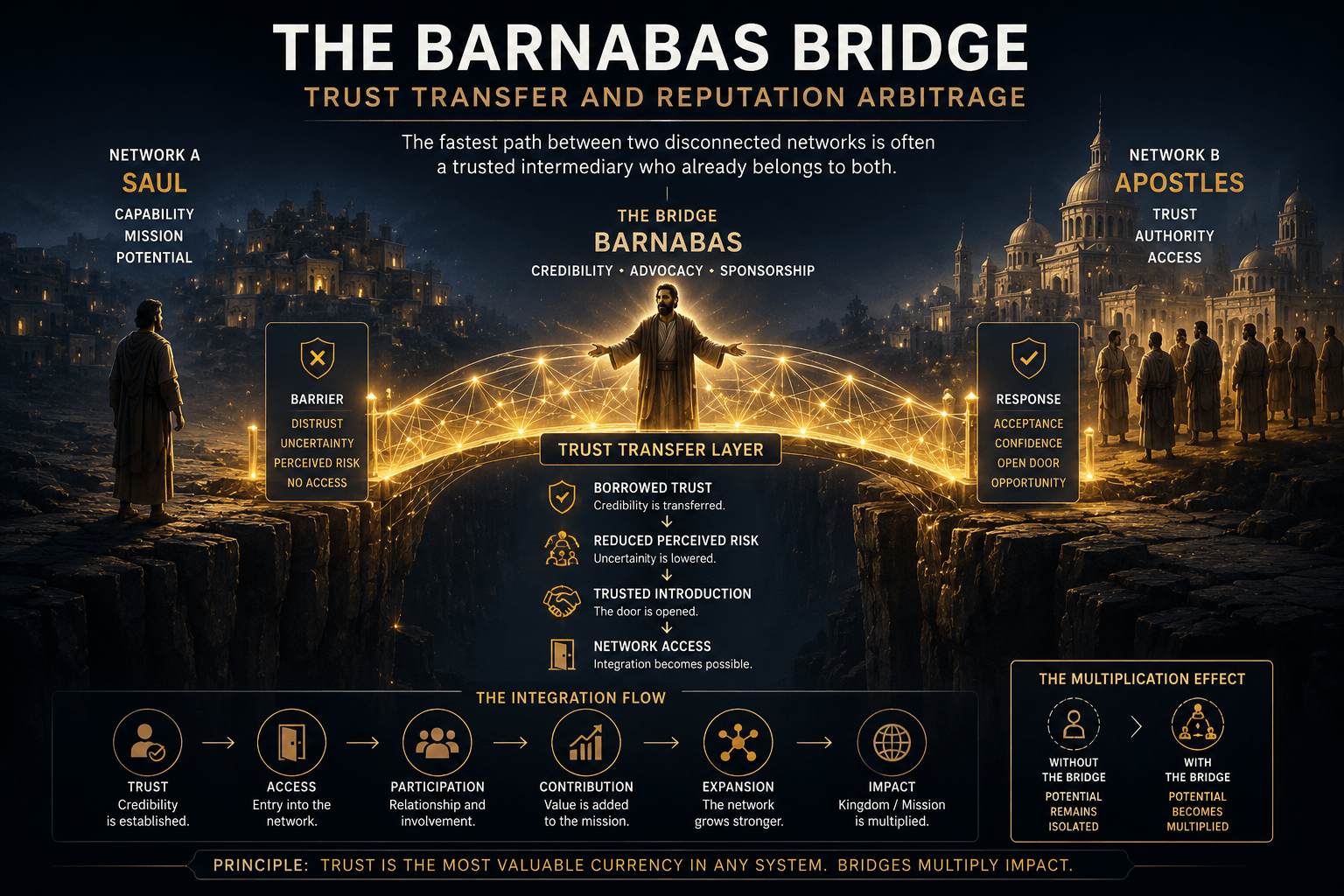
THE BARNABAS BRIDGE
Most opportunities are not blocked by capability.
They are blocked by trust.
Organizations, communities, and networks rarely evaluate individuals based solely upon their potential. They evaluate them based upon reputation, history, and perceived risk.
This creates a recurring problem.
Talented individuals often remain excluded from valuable networks because they lack credibility with the people controlling access.
The Book of Acts presents one of history’s clearest examples of trust transfer overcoming this barrier.
After his dramatic conversion, Saul of Tarsus faced a credibility crisis.
His transformation was genuine.
His capabilities were substantial.
His mission was clear.
Yet few believed him.
Viewed through a systems architecture lens, Barnabas reveals a framework for understanding how trusted intermediaries accelerate integration, reduce perceived risk, and create opportunities that would otherwise remain inaccessible.
The Barnabas Bridge explores how trust transfer, reputation arbitrage, and strategic sponsorship enable individuals and ideas to move between disconnected networks.
1. The Credibility Gap
Capability Without Acceptance
Following his conversion, Saul attempts to join the disciples.
The response is immediate skepticism.
“They were all afraid of him, not believing that he really was a disciple.” — Acts 9:26
The issue was not competence.
The issue was trust.
Capability
      +
Mission
      +
Potential

      ≠

Acceptance
The network lacked sufficient confidence to absorb the new participant.
2. The Bridge Layer
Trusted Intermediaries Create Access
The breakthrough occurs through Barnabas.
“But Barnabas took him and brought him to the apostles.” — Acts 9:27
Barnabas functions as a bridge between two disconnected groups.
He transfers trust.
He reduces uncertainty.
He validates the signal.
Network A
     ↓
 Barnabas
     ↓
Network B
The relationship becomes the infrastructure.
3. The Reputation Arbitrage Layer
Borrowing Established Trust
Barnabas possesses something Saul lacks.
Credibility.
The apostles trust Barnabas.
Because they trust him, they become willing to reconsider Saul.
Barnabas Reputation
          ↓
Trust Transfer
          ↓
Reduced Perceived Risk
          ↓
Network Access
This is reputation arbitrage.
Not manipulation.
Not deception.
Legitimate credibility being extended to a new participant.
4. The Integration Layer
Accelerating Adoption
Once accepted, Saul rapidly becomes an active contributor.
“So Saul stayed with them and moved about freely in Jerusalem.” — Acts 9:28
The barrier was never capability.
The barrier was entry.
Once trust was established, participation became possible.
Trust
    ↓
Access
    ↓
Participation
    ↓
Contribution
5. The Multiplication Layer
Bridges Expand Entire Networks
Barnabas did not merely help Saul.
He altered the trajectory of an entire movement.
Without the bridge:
Potential
     ↓
Isolation
With the bridge:
Potential
     ↓
Connection
     ↓
Expansion
     ↓
Impact
Networks often grow through trusted introductions more than direct recruitment.
The Sovereign Implication
The Barnabas Bridge reveals that trust is one of the most valuable assets within any system.
Many leaders focus on:
- talent,
- intelligence,
- resources,
- and execution.
Yet opportunities frequently flow through credibility rather than capability.
For leaders, builders, organizations, and sovereign operators, the lesson remains timeless:
- cultivate trust before you need it,
- become a reliable bridge for others,
- recognize the value of sponsorship,
- reduce uncertainty for stakeholders,
- and understand that reputation can accelerate integration where credentials alone cannot.
Because many doors are not opened by ability.
They are opened by trust.
That is the principle behind the Barnabas Bridge:
