
Resilience Before Predictable Disruption
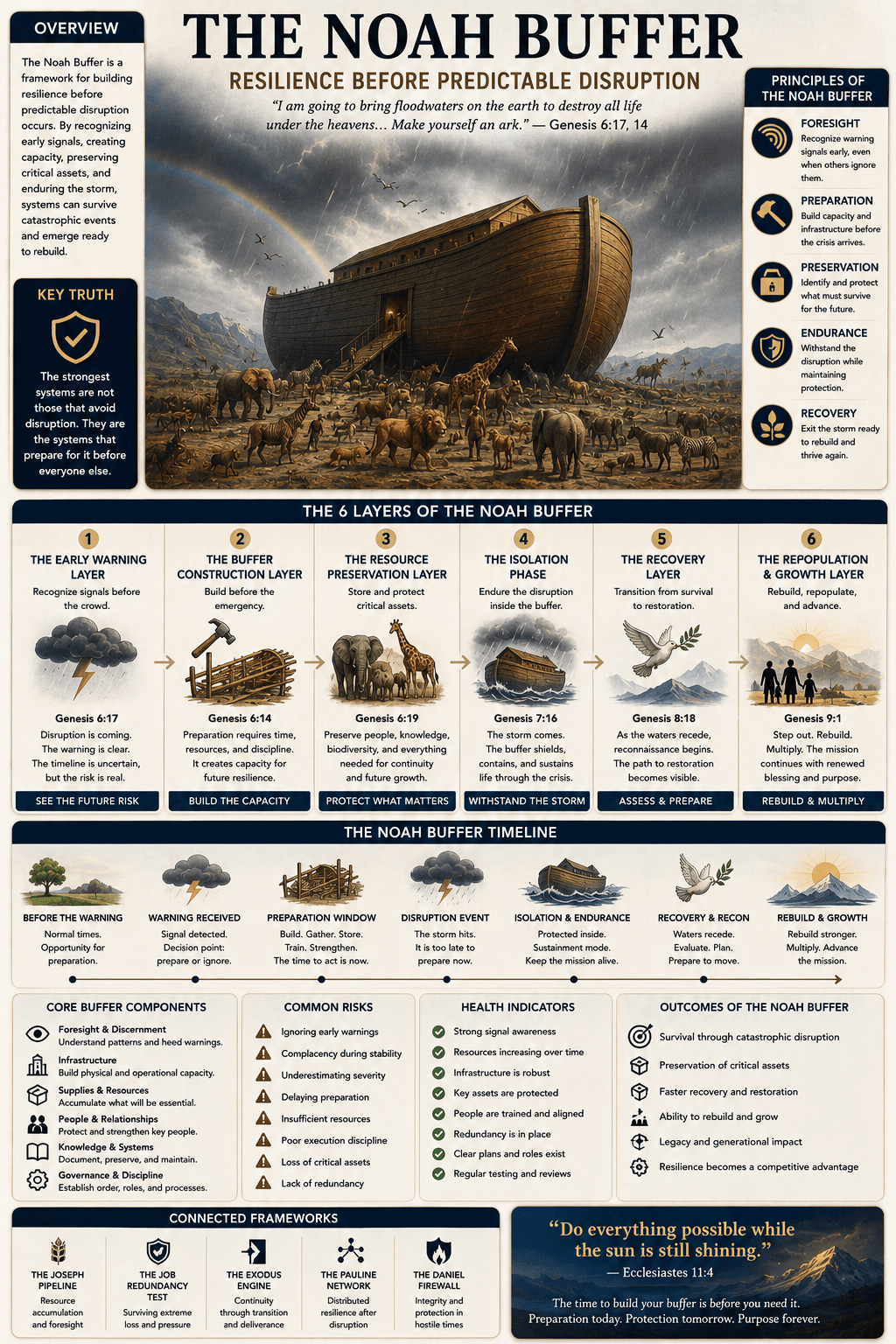
THE NOAH BUFFER
Most systems fail long before the disruption arrives.
The collapse simply makes the failure visible.
By the time a crisis appears on the horizon, the outcome is often already determined by decisions made years earlier.
The organizations that survive major disruptions rarely succeed because they react faster.
They succeed because they prepared earlier.
The account of Noah presents one of history’s most striking examples of long-term resilience planning.
A disruptive event was approaching.
The warning was clear.
The timeline was uncertain.
The consequences would be catastrophic.
Most ignored the signal.
Noah did not.
Viewed through a systems architecture lens, the story reveals a framework for building resilience before predictable disruption occurs.
The Noah Buffer explores how foresight, preparation, resource accumulation, and disciplined execution enable systems to survive events that overwhelm everyone else.
1. The Early Warning Layer
Recognizing Signals Before the Crowd
Every resilience strategy begins with signal recognition.
Before construction begins, Noah receives information others either dismiss or fail to understand.
“I am going to bring floodwaters on the earth to destroy all life under the heavens.” — Genesis 6:17
The disruption has not yet occurred.
The environment appears stable.
Yet the warning exists.
Future Risk
       ↓
Signal Detection
       ↓
Preparation Window
Most systems fail because they confuse current stability with future security.
Noah does not.
2. The Buffer Construction Layer
Building Before the Emergency
Once the warning is understood, Noah begins constructing capacity.
“Make yourself an ark.” — Genesis 6:14
This instruction is significant.
The ark produces no immediate return.
It generates no short-term reward.
It solves a future problem.
Preparation
       ↓
Capacity Creation
       ↓
Future Resilience
This is the essence of buffering.
Resources are accumulated before they become necessary.
3. The Resource Preservation Layer
Storing Critical Assets
The ark serves a second function.
It preserves continuity.
Not merely survival.
Continuity.
Animals.
Knowledge.
Families.
Future generations.
All are protected inside the buffer.
“You are to bring into the ark two of all living creatures.” — Genesis 6:19
Critical Assets
        ↓
Protection Layer
        ↓
Continuity Preservation
The strongest resilience systems identify what must survive before disruption arrives.
4. The Isolation Phase
Enduring the Disruption
Eventually the event occurs.
The preparation window closes.
The flood begins.
At this point, preparation is no longer possible.
Only execution remains.
“Then the Lord shut him in.” — Genesis 7:16
Preparation Phase
       ↓
Disruption Event
       ↓
Protected Operation
The ark’s value becomes visible only after conditions deteriorate.
This pattern repeats throughout history.
Buffers appear unnecessary until they become indispensable.
5. The Recovery Layer
Transitioning Back Into Growth
The objective was never permanent isolation.
The objective was continuity beyond disruption.
When the waters recede, Noah emerges prepared to rebuild.
“Then God blessed Noah and his sons.” — Genesis 9:1
Survival
      ↓
Recovery
      ↓
Reconstruction
      ↓
Growth
Resilience succeeds when a system remains capable of operating after the disruption passes.
The Sovereign Implication
The Noah Buffer reveals that resilience is built before it is needed.
Many organizations focus exclusively on:
- growth,
- expansion,
- optimization,
- and immediate performance.
Few dedicate sufficient resources to preparedness.
Yet disruptions are inevitable.
Economic downturns.
Infrastructure failures.
Leadership transitions.
Market shifts.
External shocks.
For leaders, builders, organizations, and sovereign operators, the lesson remains timeless:
- recognize warning signals early,
- build capacity before emergencies arise,
- protect critical assets,
- prepare for periods of isolation,
- and maintain continuity beyond disruption.
Because resilience is rarely created during the crisis itself.
It is created beforehand.
That is the principle behind the Noah Buffer:
