
Innovation Through Multi-Cultural Convergence
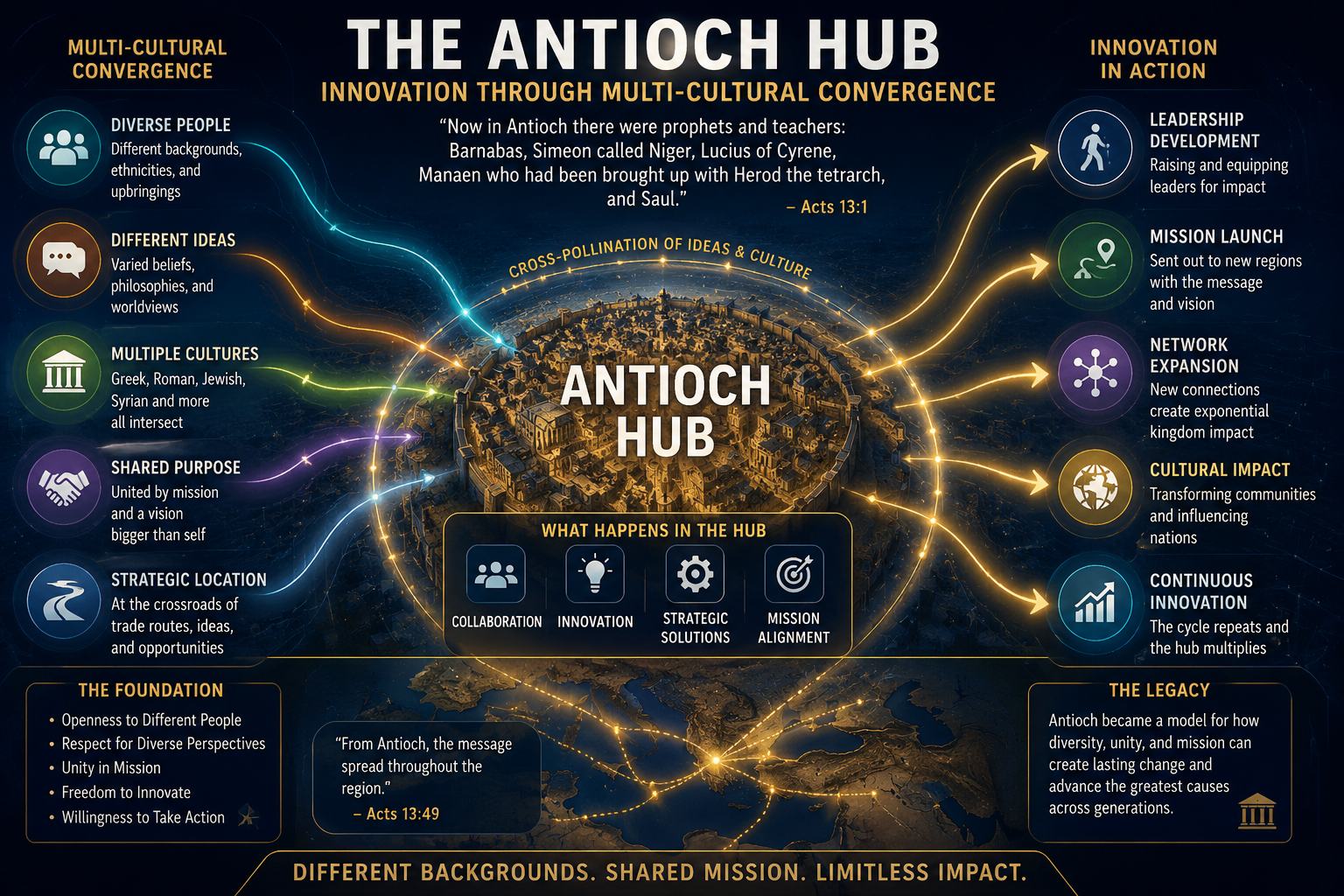
THE ANTIOCH HUB
Most innovation does not emerge from isolation.
It emerges at the intersection of different perspectives, experiences, and systems.
When people with identical assumptions gather together, they often reinforce existing patterns.
When diverse networks converge around a shared mission, entirely new possibilities emerge.
The city of Antioch represents one of the most important innovation centers in the New Testament.
Located at the crossroads of trade routes, cultures, languages, and ideas, Antioch became far more than a population center. It became an incubator for new forms of collaboration, leadership, and expansion.
While Jerusalem served as the movement’s point of origin, Antioch became the environment where new strategies, new partnerships, and new opportunities emerged.
Viewed through a systems architecture lens, Antioch reveals a framework for understanding how multi-cultural convergence accelerates innovation, expands perspective, and creates solutions that isolated systems often fail to discover.
The Antioch Hub explores how diversity of experience, decentralized collaboration, and mission alignment transform convergence into innovation.
1. The Convergence Layer
Bringing Distinct Systems Together
Antioch occupied a unique position within the ancient world.
Trade routes intersected.
Cultures interacted.
Languages mixed.
Ideas circulated.
Unlike isolated communities, Antioch functioned as a meeting point for multiple systems.
Distinct Networks
↓
Shared Environment
↓
Cross-Pollination
↓
New Possibilities
Innovation often begins where previously disconnected systems encounter one another.
2. The Perspective Layer
Diversity Expands Problem-Solving Capacity
The leadership team at Antioch reflected remarkable diversity.
“Barnabas, Simeon called Niger, Lucius of Cyrene, Manaen… and Saul.” — Acts 13:1
Different backgrounds.
Different experiences.
Different perspectives.
Yet a shared mission.
Homogeneous Teams
↓
Predictable Solutions
Diverse Teams
↓
Expanded Solution Space
The strength of the Antioch Hub was not uniformity.
It was coordinated diversity.
3. The Collaboration Layer
Mission Creates Alignment
Diversity alone does not produce innovation.
Without alignment, diversity creates fragmentation.
Antioch demonstrates a different model.
Different Participants
↓
Shared Mission
↓
Coordinated Action
↓
Collective Innovation
Mission functions as the organizing principle that converts diversity into productive collaboration.
4. The Launch Layer
Innovation Produces Expansion
Antioch became the launching point for major missionary initiatives.
“Set apart for me Barnabas and Saul for the work to which I have called them.” — Acts 13:2
The hub did not merely generate ideas.
It generated action.
Convergence
↓
Innovation
↓
Deployment
↓
Expansion
Healthy innovation ecosystems eventually produce outward movement.
5. The Network Effect Layer
Every New Connection Increases Potential
As the network expanded, new regions, cultures, and communities became connected.
Each connection increased the system’s capacity.
Network Growth
↓
Knowledge Exchange
↓
Opportunity Creation
↓
Innovation Acceleration
The value of the hub increased as participation increased.
The Sovereign Implication
The Antioch Hub demonstrates that innovation often emerges where different perspectives converge around a shared purpose.
For leaders, builders, organizations, and sovereign operators, the lesson remains clear:
- seek diverse perspectives,
- encourage cross-disciplinary collaboration,
- create environments where ideas can intersect,
- maintain mission alignment,
- and build systems that transform convergence into action.
Because breakthrough innovation rarely emerges from isolation.
It often emerges where cultures, experiences, and ideas collide constructively.
That is the principle behind the Antioch Hub:
