
Course Correction During Mission Drift
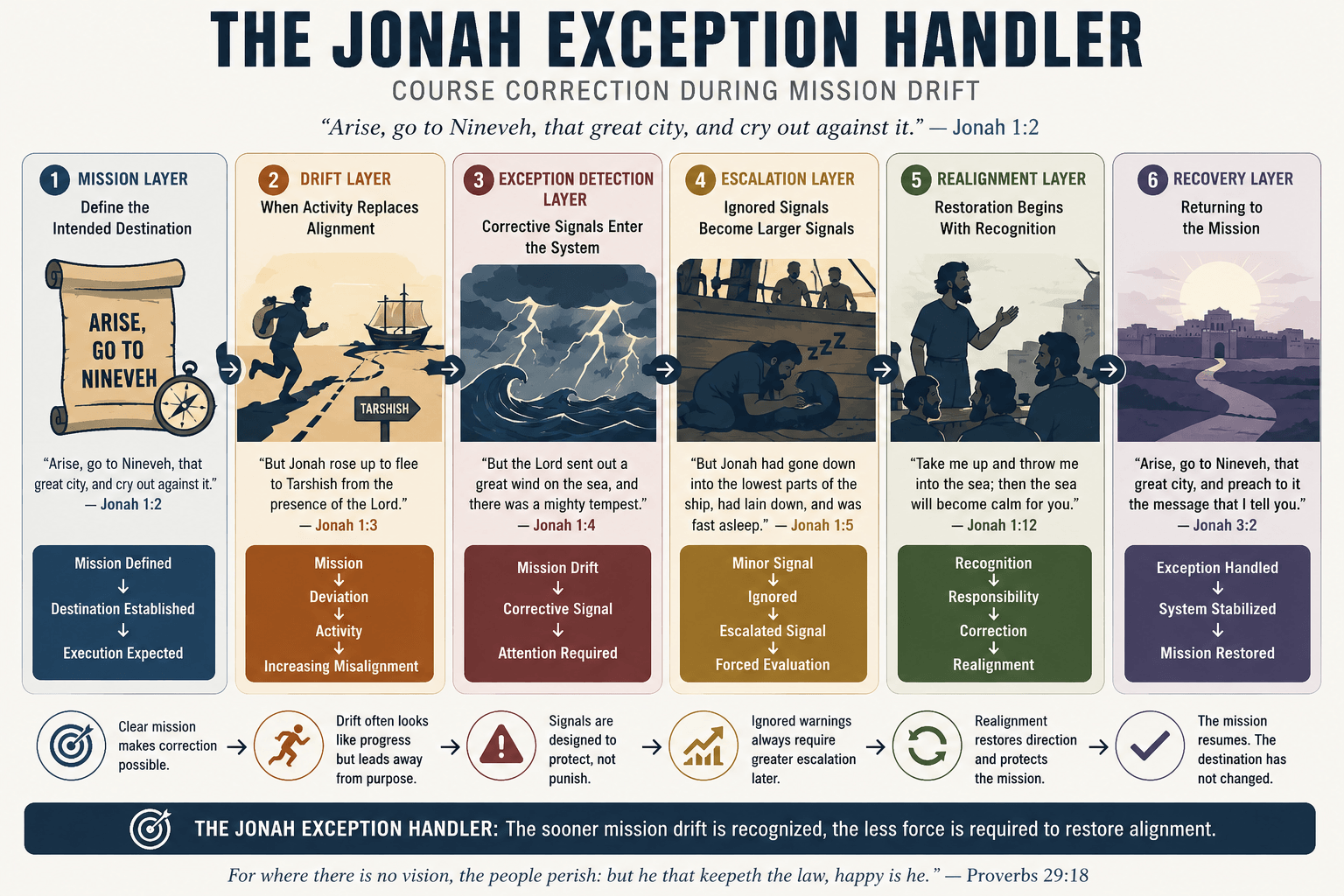
THE JONAH EXCEPTION HANDLER
Most systems do not fail because they lack a mission.
They fail because they gradually abandon it.
The drift rarely begins with rebellion.
It often begins with rationalization.
A small deviation becomes a detour.
A detour becomes a pattern.
Eventually, the system continues moving, but no longer toward its intended destination.
The Book of Jonah presents one of Scripture’s clearest examples of mission drift and corrective intervention.
The assignment could not have been more explicit:
“Arise, go to Nineveh, that great city, and cry out against it.” — Jonah 1:2
The mission was defined.
The objective was clear.
The destination was known.
Yet Jonah chose a different path.
“But Jonah rose up to flee to Tarshish from the presence of the Lord.” — Jonah 1:3
Viewed through a systems architecture lens, the Jonah narrative reveals how resilient systems identify deviation, generate corrective signals, and restore alignment before mission failure becomes permanent.
The Jonah Exception Handler explores how feedback loops, escalating intervention, and strategic realignment preserve mission integrity when systems begin drifting from their intended purpose.
1. The Mission Layer
Defining The Intended Destination
Every successful system begins with mission clarity.
Without a defined objective, alignment becomes impossible.
Jonah received a direct instruction:
“Arise, go to Nineveh…” — Jonah 1:2
Mission Defined
↓
Destination Established
↓
Execution Expected
Healthy systems establish clear objectives before execution begins.
Without a target, there can be no meaningful course correction.
2. The Drift Layer
When Activity Replaces Alignment
Jonah did not remain idle.
He took action.
He traveled.
He purchased passage.
He boarded a ship.
From the outside, he appeared productive.
Yet every step increased the distance between himself and his assignment.
“He found a ship going to Tarshish; so he paid the fare and went down into it.” — Jonah 1:3
Mission
↓
Deviation
↓
Activity
↓
Increasing Misalignment
One of the most dangerous forms of mission drift occurs when movement is mistaken for progress.
Not all motion advances the objective.
3. The Exception Detection Layer
Corrective Signals Enter The System
As Jonah moves further from his assignment, the system generates feedback.
“But the Lord sent out a great wind on the sea, and there was a mighty tempest.” — Jonah 1:4
The storm functions as an exception alert.
Its purpose is not destruction.
Its purpose is detection.
Mission Drift
↓
Corrective Signal
↓
Attention Required
Healthy organizations create similar mechanisms:
- audits,
- performance metrics,
- customer feedback,
- governance reviews,
- operational monitoring.
Without feedback, drift remains invisible.
4. The Escalation Layer
Ignored Signals Become Larger Signals
Initially, Jonah does not respond.
While everyone else struggles with the crisis, he remains asleep.
“But Jonah had gone down into the lowest parts of the ship, had lain down, and was fast asleep.” — Jonah 1:5
The warning is ignored.
The system escalates.
Questions are asked.
Responsibility is examined.
Pressure increases.
Minor Signal
↓
Ignored
↓
Escalated Signal
↓
Forced Evaluation
The longer drift persists, the stronger corrective forces become.
Many organizational failures begin as small warnings that leadership chose not to address.
5. The Realignment Layer
Restoration Begins With Recognition
The turning point occurs when Jonah acknowledges reality.
“Take me up and throw me into the sea; then the sea will become calm for you.” — Jonah 1:12
Recognition
↓
Responsibility
↓
Correction
↓
Realignment
Every effective exception handler ultimately seeks restoration.
Its purpose is not punishment.
Its purpose is alignment.
The objective is returning the system to its intended trajectory.
6. The Recovery Layer
Returning To The Mission
After intervention, Jonah receives the assignment again.
Remarkably, the mission itself has not changed.
“Arise, go to Nineveh, that great city, and preach to it the message that I tell you.” — Jonah 3:2
The system has been corrected.
The destination remains.
The mission resumes.
Exception Handled
↓
System Stabilized
↓
Mission Restored
The strongest systems are not those that never drift.
They are those capable of detecting and correcting drift before failure becomes irreversible.
The Sovereign Implication
The Jonah Exception Handler demonstrates that mission drift is one of the most persistent threats facing any organization, leader, or system.
For builders, institutions, and independent operators, the lesson remains clear:
- define the mission,
- monitor for deviation,
- establish feedback mechanisms,
- respond to corrective signals,
- and realign before drift becomes collapse.
Because systems rarely fail all at once.
More often, they gradually move away from their intended purpose until corrective pressure becomes unavoidable.
That is the principle behind the Jonah Exception Handler:
