
Ethical Capital Allocation and Sustainable Prosperity
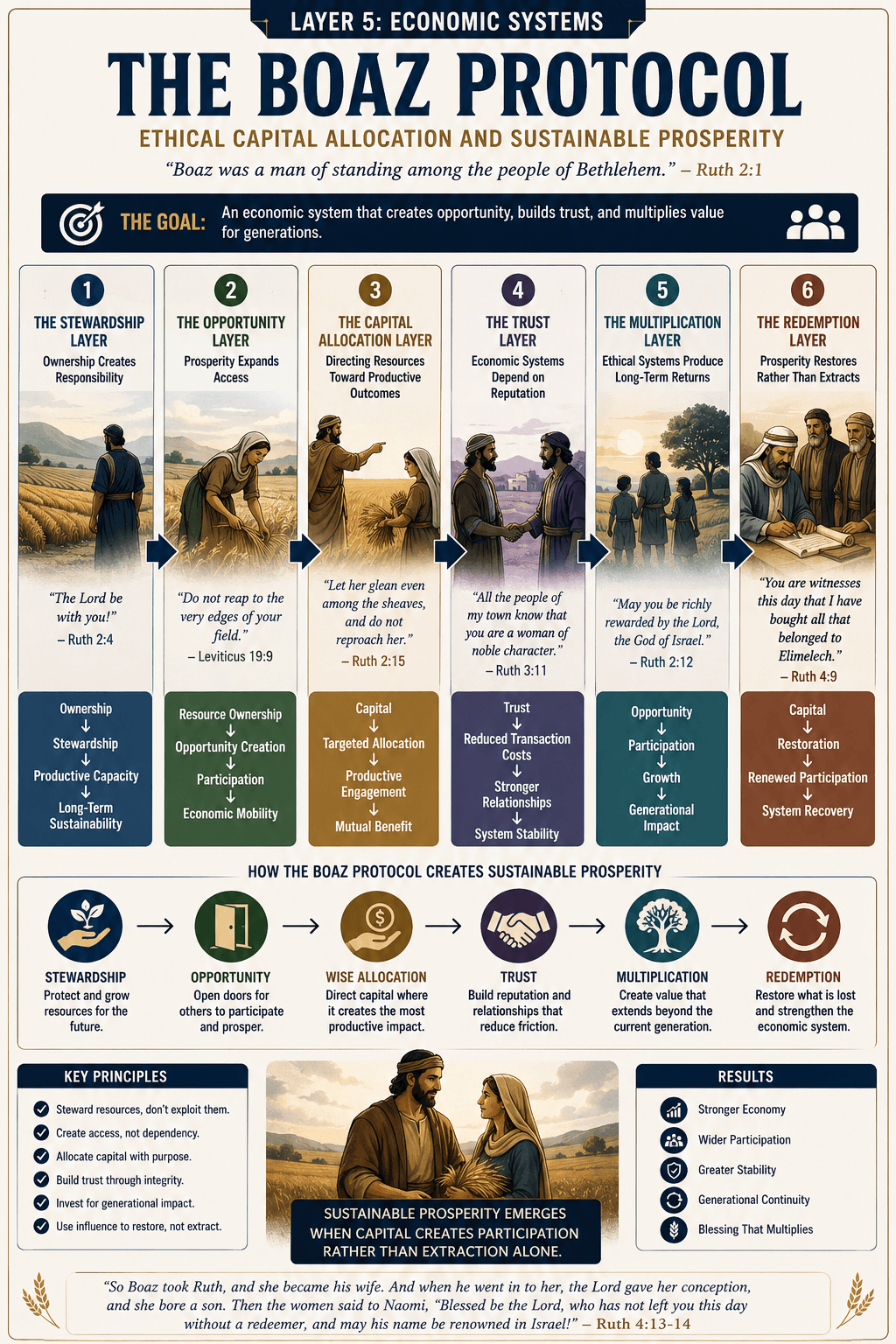
THE BOAZ PROTOCOL
Most economic systems focus on extraction.
The objective is simple:
Acquire more.
Produce more.
Consume more.
Yet history repeatedly demonstrates that prosperity built solely upon extraction often proves fragile.
Sustainable prosperity emerges when wealth creation, stewardship, and opportunity remain aligned.
The Book of Ruth presents one of Scripture’s most remarkable examples of economic activity operating alongside ethical responsibility.
Boaz is a successful landowner.
He possesses resources, influence, and productive assets.
Yet his wealth is not defined solely by accumulation.
His economic system creates opportunity for others while preserving long-term productivity.
Viewed through a systems architecture lens, the Boaz narrative reveals a framework for understanding how capital, labor, and stewardship can operate together without sacrificing either profitability or human dignity.
The Boaz Protocol explores how ethical capital allocation, productive investment, and opportunity creation generate sustainable prosperity across entire communities.
1. The Stewardship Layer
Ownership Creates Responsibility
Boaz possesses productive assets.
Fields.
Workers.
Infrastructure.
Supply chains.
Yet Scripture presents ownership as stewardship rather than exploitation.
“Now behold, Boaz came from Bethlehem and said to the reapers, ‘The Lord be with you!'” — Ruth 2:4
Ownership
↓
Stewardship
↓
Productive Capacity
↓
Long-Term Sustainability
The strongest economic systems recognize that resources must be maintained, not merely consumed.
2. The Opportunity Layer
Prosperity Expands Access
Boaz follows the provisions established in the Law regarding gleaning.
“When you reap the harvest of your land, do not reap to the very edges of your field.” — Leviticus 19:9
This creates a structured mechanism through which vulnerable individuals can participate in productive activity.
Resource Ownership
↓
Opportunity Creation
↓
Participation
↓
Economic Mobility
The objective is neither dependency nor exclusion.
The objective is access.
3. The Capital Allocation Layer
Directing Resources Toward Productive Outcomes
When Boaz notices Ruth, he does not simply provide charity.
He allocates resources strategically.
“Let her glean even among the sheaves, and do not reproach her.” — Ruth 2:15
Capital
↓
Targeted Allocation
↓
Productive Engagement
↓
Mutual Benefit
Effective capital allocation increases the productive capacity of the entire system.
4. The Trust Layer
Economic Systems Depend Upon Reputation
Boaz’s influence extends beyond land ownership.
His reputation creates stability.
Trust reduces friction.
Trust attracts participation.
Trust encourages cooperation.
“All the people of my town know that you are a woman of noble character.” — Ruth 3:11
Trust
↓
Reduced Transaction Costs
↓
Stronger Relationships
↓
System Stability
Economic systems operate more efficiently when trust is abundant.
5. The Multiplication Layer
Ethical Systems Produce Long-Term Returns
The relationship between Boaz and Ruth ultimately creates outcomes extending far beyond either individual.
Opportunity
↓
Participation
↓
Growth
↓
Generational Impact
The immediate harvest produces food.
The broader system produces continuity.
The strongest investments often create value beyond the current cycle.
6. The Redemption Layer
Prosperity Restores Rather Than Extracts
Boaz functions as a kinsman-redeemer.
He uses resources, influence, and legal mechanisms to restore opportunity.
“Boaz said to the elders and all the people, ‘You are witnesses this day that I have bought all that belonged to Elimelech.'” — Ruth 4:9
Capital
↓
Restoration
↓
Renewed Participation
↓
System Recovery
Healthy economic systems possess mechanisms that allow restoration after hardship.
The Sovereign Implication
The Boaz Protocol demonstrates that sustainable prosperity emerges when stewardship, opportunity, and capital remain aligned.
For entrepreneurs, investors, business leaders, and economic architects, the lesson remains clear:
- steward resources responsibly,
- create opportunities for participation,
- allocate capital productively,
- build trust within the system,
- and pursue prosperity that strengthens the broader network.
Because the strongest economies do not merely generate wealth.
They generate opportunity.
That is the principle behind the Boaz Protocol:
