
THE JOB REDUNDANCY TEST
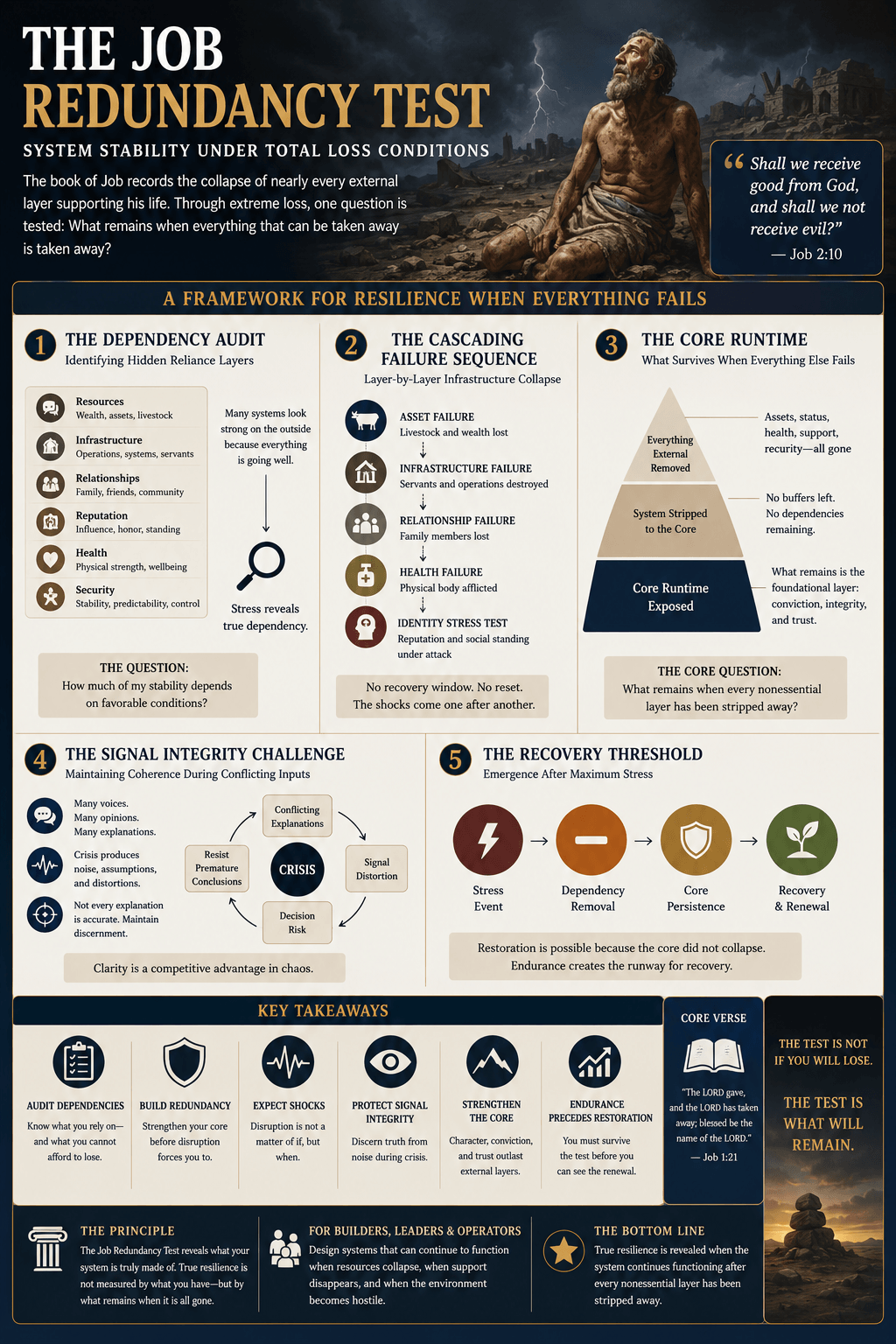
System Stability Under Total Loss Conditions
Most systems appear resilient until they encounter a stress event.
During periods of abundance, stability is easy to mistake for strength.
Revenue is flowing.
Relationships are intact.
Infrastructure is functioning.
The environment appears predictable.
But resilience is not measured during favorable conditions.
Resilience is measured after the shock arrives.
The Book of Job presents one of the most extreme stress tests ever recorded.
Within a compressed sequence of events, Job experiences the collapse of nearly every external layer supporting his life:
- wealth,
- infrastructure,
- family,
- reputation,
- health,
- and social support.
The losses are not incremental.
They are cascading.
Each layer fails before the previous shock has been fully processed.
Viewed through a systems architecture lens, Job reveals a framework for:
System Stability Under Total Loss Conditions
The Job Redundancy Test examines what happens when external dependencies fail simultaneously and the core operating system is forced to function without its usual support structures.
1. The Dependency Audit
Identifying Hidden Reliance Layers
At the beginning of the narrative, Job possesses remarkable stability.
“This man was blameless and upright, one who feared God and turned away from evil.” — Job 1:1
He also possesses extraordinary resources:
- livestock,
- servants,
- influence,
- family,
- and social standing.
From the outside, the system appears exceptionally strong.
The stress test reveals a crucial question:
How much of that strength depends upon favorable conditions?
Resources
      ↓
Comfort
      ↓
Perceived Stability

Stress Event
      ↓
True Stability Revealed
Many systems never perform this audit voluntarily.
Crisis performs it automatically.
The Job Redundancy Test begins by exposing hidden dependencies.
2. The Cascading Failure Sequence
Layer-by-Layer Infrastructure Collapse
The losses arrive in rapid succession.
Livestock disappear.
Servants die.
Infrastructure fails.
Family members are lost.
The sequence becomes so severe that the messengers overlap.
“While he was yet speaking, there came another…” — Job 1:16
Then again:
“While he was yet speaking…” — Job 1:17
And again:
“While he was yet speaking…” — Job 1:18
Asset Failure
       ↓
Infrastructure Failure
       ↓
Relationship Failure
       ↓
Health Failure
       ↓
Identity Stress Test
The speed matters.
The system receives no recovery window.
No stabilization period.
No opportunity to rebuild before the next disruption arrives.
The protocol is testing not merely resources.
It is testing continuity.
3. The Core Runtime
What Survives When Everything Else Fails
Eventually the stress event reaches the deepest layers of the system.
Job loses health.
His social network fractures.
Even those closest to him begin questioning the value of endurance.
His wife tells him:
“Curse God and die.” — Job 2:9
Yet Job responds:
“Shall we receive good from God, and shall we not receive evil?” — Job 2:10
The framework reaches its central question:
What remains when external reinforcement disappears?
Assets Removed
       ↓
Status Removed
       ↓
Health Removed
       ↓
Core Runtime Exposed
Every system contains a foundational layer.
The Job Redundancy Test exposes it.
Some systems collapse immediately.
Others reveal unexpected durability.
4. The Signal Integrity Challenge
Maintaining Coherence During Conflicting Inputs
As the narrative progresses, Job encounters competing interpretations.
Friends offer explanations.
Accusations emerge.
Assumptions multiply.
Each participant attempts to explain the disruption through their own framework.
Yet many of those frameworks prove incomplete.
Crisis
      ↓
Conflicting Explanations
      ↓
Signal Distortion
      ↓
Decision Risk
The challenge is no longer merely survival.
The challenge becomes preserving signal integrity while surrounded by noise.
The Job Redundancy Test teaches:
Not every explanation generated during a crisis is accurate.
Maintaining coherence often requires resisting premature conclusions.
5. The Recovery Threshold
Emergence After Maximum Stress
Eventually the testing cycle ends.
The narrative concludes with restoration.
But the restoration is not the primary lesson.
The primary lesson is that the system remained operational long enough to reach recovery.
Stress Event
      ↓
Dependency Removal
      ↓
Core Runtime Exposure
      ↓
System Persistence
      ↓
Recovery
Recovery becomes possible because continuity survived.
The framework is not fundamentally about loss.
It is about endurance.
The Sovereign Implication
The Job Redundancy Test reveals that resilience cannot be measured solely by growth, prosperity, or favorable conditions.
Every system eventually encounters disruption.
The decisive question becomes:
What survives after the dependencies disappear?
For leaders, builders, organizations, and sovereign operators, the lesson remains timeless:
- identify hidden dependencies,
- recognize the difference between comfort and resilience,
- maintain signal integrity during crisis,
- and strengthen the core operating layer before disruption arrives.
Because the strongest systems are not those that avoid testing.
They are the systems that remain coherent after the test begins.
That is the principle behind the Job Redundancy Test:
True resilience is revealed when the system continues functioning after every nonessential layer has been stripped away.
This one naturally links to:
Continue Exploring the Framework Library:
→ The Joseph Pipeline
Discover how resilient systems preserve continuity and emerge stronger through periods of disruption and uncertainty.
→ The Noah Buffer
Explore why the strongest systems prepare for disruption before the storm becomes visible.
→ The Daniel Firewall
Learn how integrity, conviction, and operational discipline survive pressure from hostile environments.
→ The Elijah Sub-Routine
Examine how isolated and distributed nodes maintain continuity when centralized systems fail.
