
Integrity Preservation Inside Hostile Systems
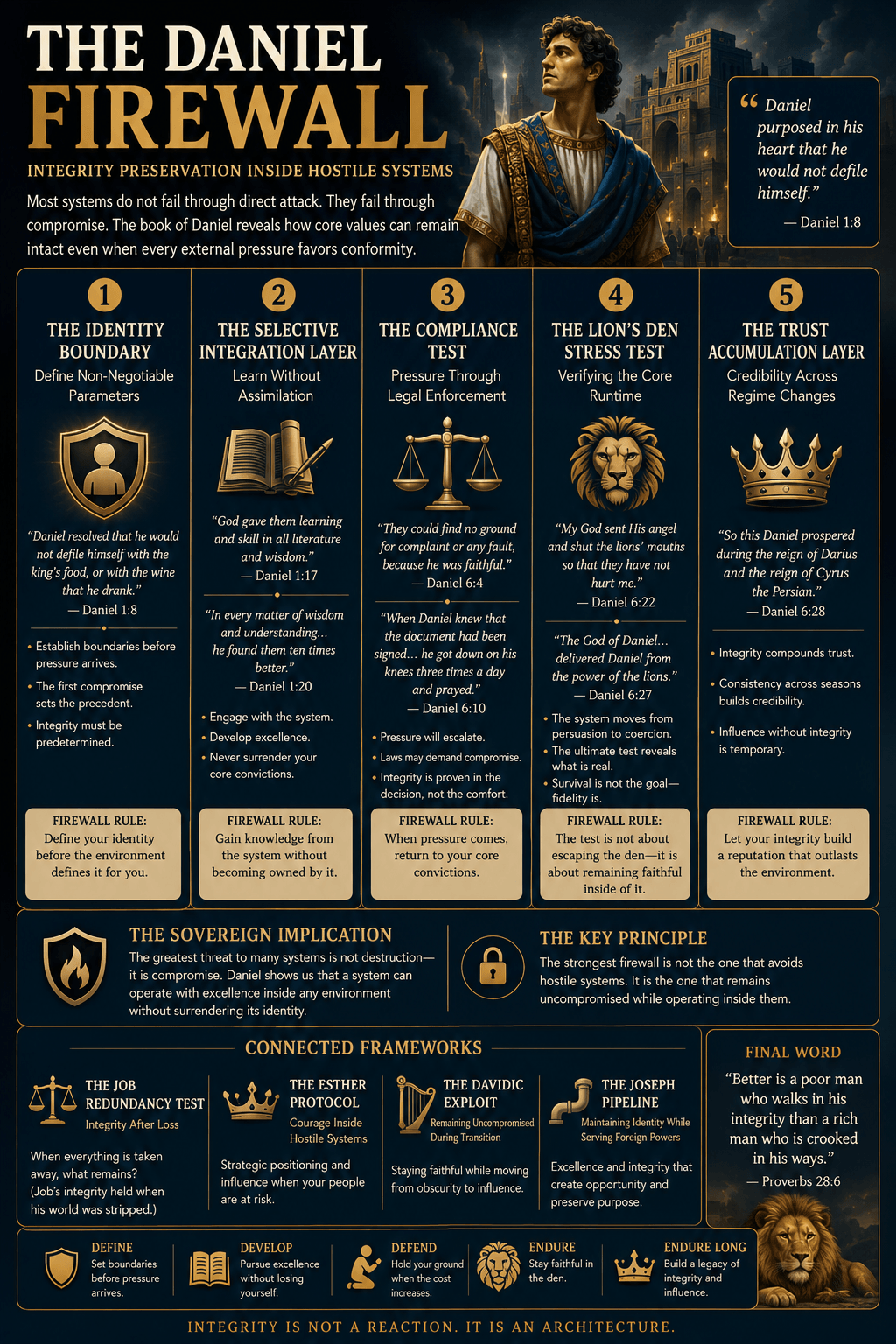
THE DANIEL FIREWALL
Most systems do not fail through direct attack.
They fail through gradual compromise.
A small exception.
A convenient shortcut.
A minor concession made in exchange for acceptance, advancement, or survival.
Over time, the architecture changes.
The external structure remains intact.
The internal operating system does not.
The Book of Daniel presents one of the most sophisticated integrity preservation case studies in Scripture.
Daniel is removed from Jerusalem.
His homeland falls.
His environment changes.
His language changes.
His education changes.
His social network changes.
Every surrounding variable is redesigned to facilitate assimilation into the Babylonian system.
Yet Daniel repeatedly demonstrates an unusual characteristic:
He participates without becoming absorbed.
Viewed through a systems architecture lens, Daniel reveals a blueprint for:
Integrity Preservation Inside Hostile Systems
The Daniel Firewall examines how core operating principles survive inside environments designed to rewrite them.
1. The Identity Boundary
Defining Non-Negotiable Parameters
Upon arriving in Babylon, Daniel immediately encounters the first assimilation protocol.
The king’s provisions are assigned.
Participation is expected.
Compliance is assumed.
Yet the text records a critical decision:
“But Daniel resolved that he would not defile himself with the king’s food, or with the wine that he drank.” — Daniel 1:8
This is the first firewall rule.
The issue is not food.
The issue is authority.
Daniel establishes a boundary before pressure intensifies.
External Pressure
        ↓
Boundary Definition
        ↓
Identity Preservation
Most systems fail because they attempt to define their principles during a crisis.
Daniel defines them before the crisis arrives.
The firewall begins with a foundational principle:
Integrity must be predetermined.
2. The Selective Integration Layer
Learning Without Assimilation
Daniel does not isolate himself from Babylon.
He studies.
He learns.
He develops expertise.
The text states:
“God gave them learning and skill in all literature and wisdom.” — Daniel 1:17
And later:
“In every matter of wisdom and understanding… he found them ten times better.” — Daniel 1:20
This distinction is essential.
Daniel is not anti-system.
He is anti-compromise.
Reject Everything
        ↓
Isolation

Accept Everything
        ↓
Assimilation

Selective Integration
        ↓
Influence Without Absorption
The firewall does not block learning.
It blocks corruption of the core runtime.
Daniel proves a system can acquire knowledge without surrendering identity.
3. The Compliance Test
Pressure Through Legal Enforcement
As Daniel’s influence grows, opposition develops.
His rivals search for vulnerabilities.
They audit his behavior.
They inspect his record.
The result is remarkable:
“They could find no ground for complaint or any fault, because he was faithful.” — Daniel 6:4
Unable to exploit corruption, they attack conviction instead.
A decree is issued.
Prayer becomes illegal.
The system now demands compliance.
Daniel’s response is immediate:
“When Daniel knew that the document had been signed, he went to his house… and got down on his knees three times a day and prayed.” — Daniel 6:10
Pressure
      ↓
Compliance Demand
      ↓
Decision Point
      ↓
Integrity Validation
The firewall is now operating under load.
4. The Lion’s Den Stress Test
Verifying the Core Runtime
Daniel is thrown into the lions’ den.
The system has exhausted persuasion.
Now it deploys coercion.
The objective is no longer assimilation.
The objective is surrender.
Assimilation Attempt
          ↓
Political Pressure
          ↓
Legal Enforcement
          ↓
Coercive Stress Test
The king later declares:
“The God of Daniel… delivered Daniel from the power of the lions.” — Daniel 6:27
The framework reaches its central question:
Can the core operating system survive direct pressure?
A firewall has no value until it encounters attack.
The lion’s den reveals whether the protection layer is real.
5. The Trust Accumulation Layer
Credibility Across Regime Changes
One of the most overlooked features of Daniel’s story is longevity.
Kings change.
Empires change.
Political environments change.
Daniel remains.
The text records:
“So this Daniel prospered during the reign of Darius and the reign of Cyrus the Persian.” — Daniel 6:28
This is not merely survival.
It is continuity.
Integrity
      ↓
Trust
      ↓
Credibility
      ↓
Enduring Influence
The firewall protects more than principles.
It protects operational continuity across changing environments.
Daniel becomes trusted because his core runtime remains consistent regardless of who occupies power.
The Sovereign Implication
The Daniel Firewall reveals that the greatest threat to many systems is not destruction.
It is compromise.
Most environments reward adaptation.
Few reward conviction.
Yet the most durable systems preserve their identity even while operating inside structures that pressure them to conform.
For leaders, builders, organizations, and sovereign operators, the lesson remains timeless:
- establish boundaries before pressure arrives,
- learn without assimilating,
- maintain integrity under enforcement,
- and protect the core runtime from gradual erosion.
Because influence without integrity eventually becomes dependency.
And adaptation without boundaries eventually becomes assimilation.
That is the principle behind the Daniel Firewall:
