
Hierarchical Load Balancing and Leadership Scaling
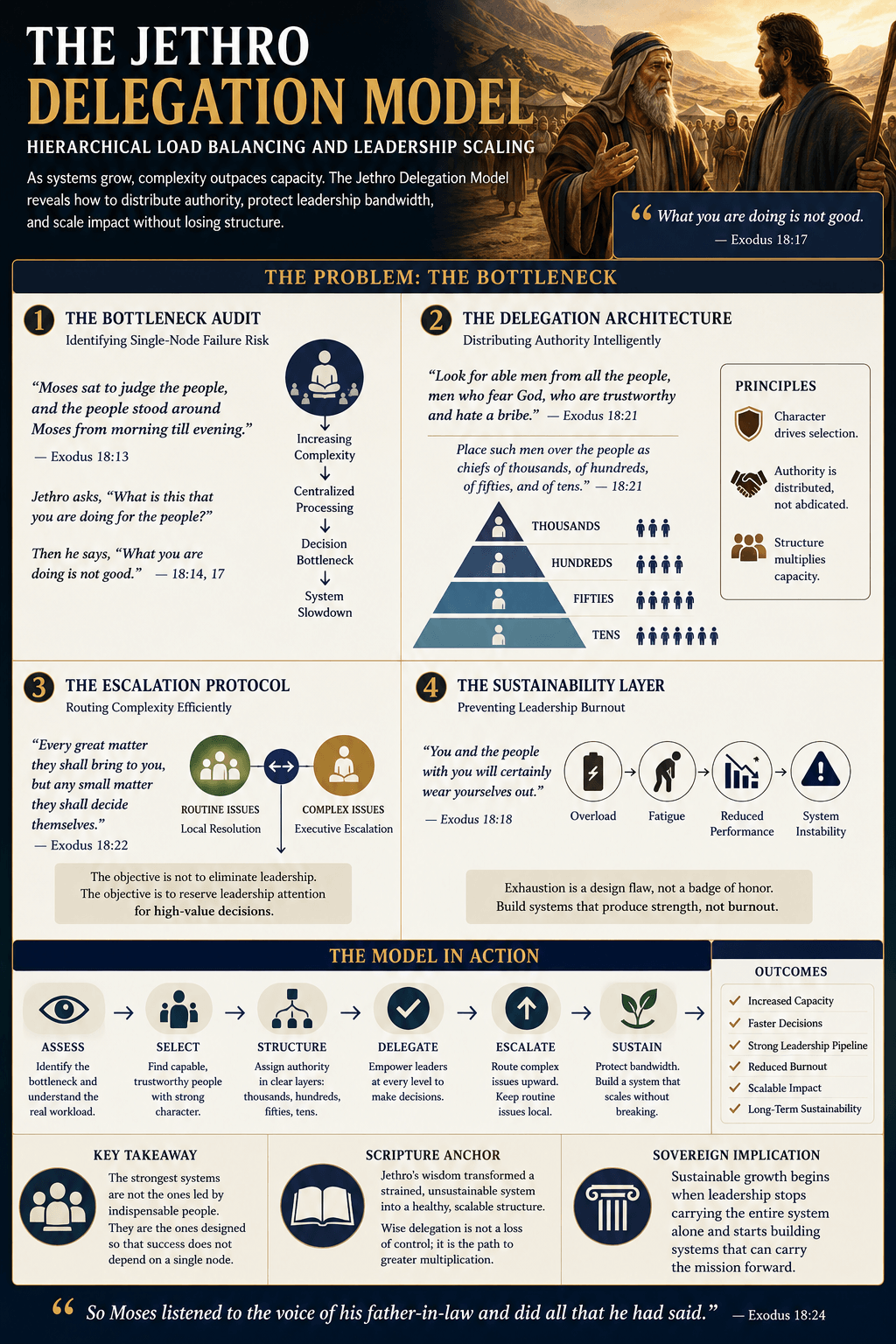
THE JETHRO DELEGATION MODEL
Most systems fail not because of external pressure.
They fail because a critical node becomes overloaded.
As organizations grow, complexity compounds.
More decisions.
More requests.
More disputes.
More communication pathways.
Initially, a single leader may be capable of processing the entire workload.
Eventually, however, scale introduces a new problem:
The system grows faster than its decision-making capacity.
The Book of Exodus presents one of the earliest recorded examples of organizational scaling failure.
Moses has successfully led Israel out of Egypt.
The migration is complete.
The community is expanding.
Yet a hidden vulnerability emerges inside the operating structure.
Moses becomes the processing center for every dispute, question, and judgment.
The entire network depends upon a single node.
His father-in-law Jethro immediately recognizes the problem.
What follows is one of the most sophisticated leadership and delegation frameworks in Scripture.
Viewed through a systems architecture lens, Jethro reveals a blueprint for:
Hierarchical Load Balancing and Leadership Scaling
The Jethro Delegation Model demonstrates how growing systems distribute authority without sacrificing coherence.
1. The Bottleneck Audit
Identifying Single-Node Failure Risk
When Jethro arrives, he observes Moses operating as the sole decision-maker.
“Moses sat to judge the people, and the people stood around Moses from morning till evening.” — Exodus 18:13
The workload appears impressive.
Jethro sees something different.
A bottleneck.
He asks:
“What is this that you are doing for the people?” — Exodus 18:14
Then he delivers a blunt assessment:
“What you are doing is not good.” — Exodus 18:17
Increasing Complexity
          ↓
Centralized Processing
          ↓
Decision Bottleneck
          ↓
System Slowdown
The first principle of the model is simple:
Heroic leadership does not scale.
A system dependent upon one individual eventually becomes constrained by that individual’s capacity.
2. The Delegation Architecture
Distributing Authority Intelligently
Jethro proposes a radically different structure.
Rather than centralizing every decision, authority is distributed through multiple layers.
“Look for able men from all the people, men who fear God, who are trustworthy and hate a bribe.” — Exodus 18:21
The model is not random delegation.
It is selective delegation.
Character becomes part of the architecture.
Then Jethro introduces the hierarchy:
“Place such men over the people as chiefs of thousands, of hundreds, of fifties, and of tens.” — Exodus 18:21
Thousands
     ↓
Hundreds
     ↓
Fifties
     ↓
Tens
The workload is now distributed across multiple processing layers.
The system gains capacity without losing structure.
3. The Escalation Protocol
Routing Complexity Efficiently
Not every problem requires executive attention.
Jethro understands that routine issues should be resolved at the lowest effective level.
“Every great matter they shall bring to you, but any small matter they shall decide themselves.” — Exodus 18:22
Routine Issues
       ↓
Local Resolution

Complex Issues
       ↓
Executive Escalation
This principle remains foundational to modern organizations.
The objective is not to eliminate leadership.
The objective is to reserve leadership attention for high-value decisions.
Every minute spent resolving routine disputes reduces capacity for strategic thinking.
The Jethro Model protects executive bandwidth.
4. The Sustainability Layer
Preventing Leadership Burnout
Jethro’s warning becomes one of the most important scalability lessons in Scripture:
“You and the people with you will certainly wear yourselves out.” — Exodus 18:18
The problem is not merely inefficiency.
The problem is exhaustion.
Overload
      ↓
Fatigue
      ↓
Reduced Performance
      ↓
System Instability
Many leaders mistakenly interpret exhaustion as commitment.
The Jethro Model sees exhaustion as a design flaw.
A healthy system should not depend on perpetual overextension.
Sustainability must be engineered into the structure itself.
The Sovereign Implication
The Jethro Delegation Model teaches that growth eventually requires architecture.
What begins as a small, founder-driven operation cannot remain structured that way indefinitely.
As complexity increases, sustainable systems must:
- distribute responsibility,
- develop trusted operators,
- create escalation pathways,
- and protect leadership bandwidth.
The objective is not to remove authority.
The objective is to scale authority.
For builders, founders, organizations, and sovereign operators, the lesson remains timeless:
- identify bottlenecks,
- delegate intentionally,
- reserve executive attention for high-impact decisions,
- and build structures capable of growing beyond a single individual.
Because the strongest systems are not the ones led by indispensable people.
They are the ones designed so that success no longer depends upon a single node.
That is the principle behind the Jethro Delegation Model:
Sustainable growth begins when leadership stops carrying the entire system alone.
Continue Exploring the Framework Library:
→ The Nehemiah Stack
Learn how distributed execution accelerates rebuilding by empowering local ownership and parallel action.
→ The Gideon Vector
Explore why elite systems often grow stronger through selective filtration rather than unlimited expansion.
→ The Joseph Pipeline
Discover how administrative architecture, resource management, and strategic planning create long-term organizational resilience.
→ The Solomon Matrix
Examine how leaders navigate complexity through wisdom-driven decision architecture and judgment under uncertainty.
