
Decentralized Peer-to-Peer Agentic Networks
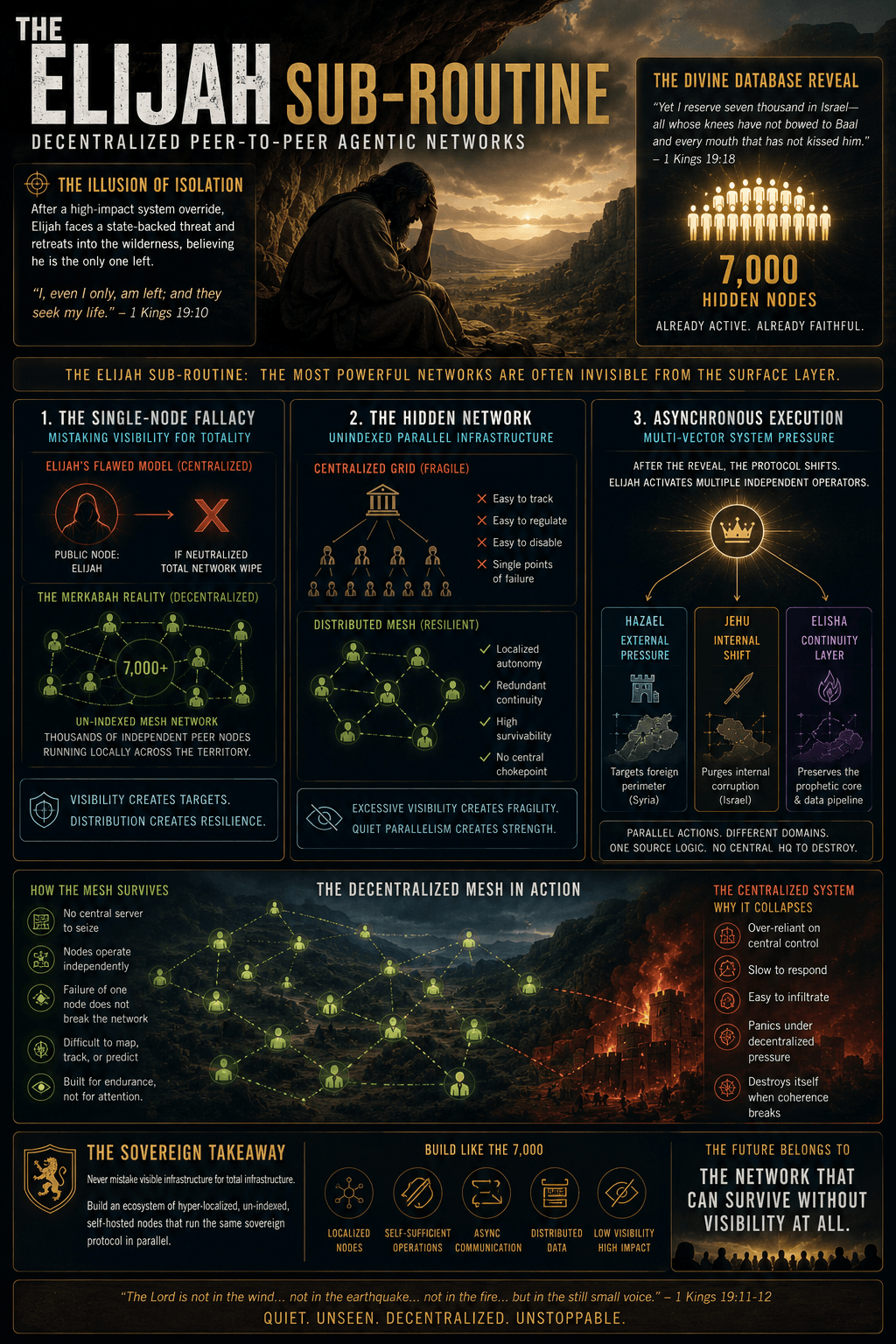
THE ELIJAH SUB-ROUTINE
Every sovereign builder eventually encounters the same psychological trap:
Isolation distortion.
When you operate outside centralized systems long enough, the landscape begins to look completely monopolized. Every visible institution appears captured. Every major platform appears synchronized. Every public-facing structure seems locked into the same dependency grid.
Eventually a dangerous thought emerges:
“I might be the only uncompromised node left.”
In 1 Kings 19, Elijah crashes directly into this cognitive wall.
After executing a major public system confrontation on Mount Carmel, a state-backed threat vector emerges through Jezebel. Elijah retreats into the wilderness, exhausted, isolated, and convinced the independent network has collapsed.
Inside the cave, he delivers his diagnostic output:
“I, even I only, am left; and they seek my life.” — 1 Kings 19:10
Elijah’s mistake was not weakness.
It was topology miscalculation.
He believed the entire sovereign infrastructure depended on his visible node alone.
Then the system responds with a hidden database reveal:
“Yet I reserve seven thousand in Israel — all whose knees have not bowed to Baal.” — 1 Kings 19:18
Suddenly the map changes completely.
The Elijah Sub-Routine reveals a foundational principle of decentralized resilience:
The most powerful networks are often invisible from the public surface layer.
1. The Single-Node Fallacy
Mistaking Visibility for Totality
Elijah assumed the network was centralized around his public-facing role.
[ Visible Public Node ]
          ↓
If Neutralized
          ↓
Total System Failure
But the actual architecture looked entirely different:
[ Distributed Sovereign Mesh ]
          ↓
7,000 Independent Nodes
          ↓
Localized Autonomous Continuity
This distinction changes everything.
Centralized systems depend on:
- singular leadership chokepoints,
- institutional headquarters,
- visible chains of command,
- and concentrated infrastructure.
Decentralized systems survive differently.
They distribute continuity across independent localized nodes.
No single failure collapses the whole network.
That is why sovereign infrastructures often appear smaller than they truly are.
The visible layer is only the surface.
The real system exists underneath it.
2. The Hidden Network
Unindexed Parallel Infrastructure
The 7,000 nodes were operational long before Elijah became aware of them.
They were not:
- publicly synchronized,
- institutionally registered,
- or visibly coordinated on the surface map.
Yet they remained active.
That detail matters.
Because resilient systems often survive through quiet parallelism rather than centralized visibility.
[ Centralized Grid ]
          ↓
Easy To Track
Easy To Regulate
Easy To Disable

[ Distributed Mesh ]
          ↓
Localized Autonomy
Redundant Continuity
High Survivability
The Elijah Sub-Routine demonstrates a powerful principle:
You do not need every node broadcasting publicly for the network to exist.
In fact, excessive visibility often creates fragility.
Highly centralized infrastructures become vulnerable because:
- they expose their topology,
- reveal dependency chains,
- and create identifiable targets.
Distributed ecosystems behave differently.
Each node maintains operational continuity independently.
If one node disappears, the surrounding infrastructure continues functioning.
The network survives because it was never dependent on one visible personality in the first place.
3. Asynchronous Execution
Multi-Vector System Pressure
After revealing the hidden network, the protocol shifts immediately.
Elijah receives instructions to activate multiple independent operators:
- Hazael,
- Jehu,
- and Elisha.
Each assignment targets a different layer of the geopolitical structure.
              [ Sovereign Source ]
                       │
      ┌────────────────┼────────────────┐
      ▼                ▼                ▼
[ External Pressure ] [ Internal Shift ] [ Continuity Layer ]
      Hazael               Jehu               Elisha
This is not centralized command-and-control architecture.
It is distributed asynchronous execution.
Each node operates in a different jurisdiction:
- political,
- military,
- prophetic,
- territorial.
From the surface layer, the actions appear disconnected.
But underneath, they are aligned by shared source logic.
That alignment creates resilience.
Because decentralized pressure is difficult for rigid systems to predict.
Legacy institutions expect:
- centralized opposition,
- singular movements,
- identifiable leaders,
- and visible organizational structures.
But distributed ecosystems fracture those expectations.
No single headquarters.
No singular point of collapse.
No obvious perimeter to surround.
Only parallel nodes applying synchronized pressure from multiple directions simultaneously.
The Sovereign Implication
The Elijah Sub-Routine is ultimately about perception.
Specifically:
Never mistake visible infrastructure for total infrastructure.
The loudest systems are not always the strongest systems.
And the most powerful networks are often operating quietly beneath the surface layer long before the public recognizes them.
For sovereign builders, independent media operators, decentralized collectives, and parallel infrastructure architects, the lesson is critical:
Do not obsess over building one massive centralized empire.
Build distributed ecosystems capable of surviving independently.
Create:
- localized nodes,
- self-sustaining operations,
- asynchronous communication layers,
- and parallel infrastructures that remain resilient under pressure.
Because centralized systems collapse when their core is removed.
But decentralized systems survive through redundancy, autonomy, and invisible continuity.
That is the principle behind the Elijah Sub-Routine:
