
Asymmetric Resource Leverage and Hyper-Vetted Node Scaling
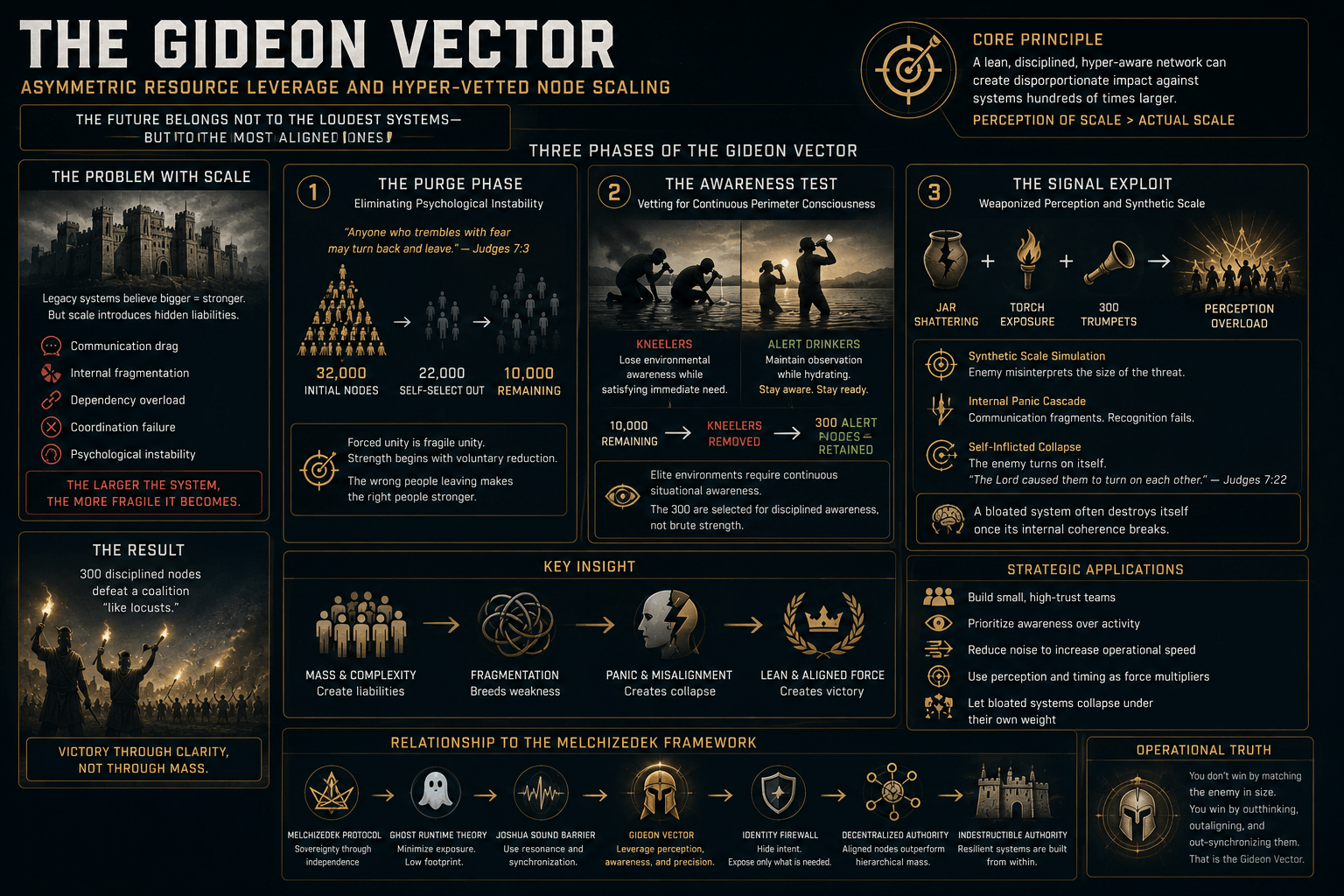
THE GIDEON VECTOR
Most systems worship scale.
More employees.
More capital.
More infrastructure.
More visibility.
More market share.
Legacy institutions operate on a simple assumption:
Bigger equals stronger.
But scale introduces hidden liabilities:
- communication drag,
- internal fragmentation,
- dependency overload,
- coordination failure,
- and psychological instability under pressure.
Massive systems often appear powerful right before they become vulnerable.
Judges 7 documents one of the most aggressive operational downsizing sequences ever recorded.
Gideon begins with 32,000 personnel preparing to face the Midianite coalition — a force described as covering the valley “like locusts.”
Yet instead of scaling upward, the system deliberately contracts.
By the end of the filtration process, the workforce collapses from:
- 32,000
to - 300.
Less than 1% of the original force remains.
And with those 300 nodes, Gideon triggers the collapse of a vastly larger system without engaging in conventional large-scale combat.
The Gideon Vector is a blueprint for:
Asymmetric Resource Leverage
A doctrine centered on reducing operational noise, hyper-vetting the core network, and using precision synchronization to destabilize bloated systems from within.
1. The Purge Phase
Eliminating Psychological Instability
The first filter is brutally simple:
“Anyone who trembles with fear may turn back and leave.” — Judges 7:3
22,000 immediately exit the network.
[ 32,000 Initial Nodes ]
↓
Psychological Stability Filter
↓
22,000 Self-Select Out
↓
10,000 Remaining
This is strategically important.

Large organizations often mistake headcount for strength.

But unaligned or psychologically unstable nodes become liabilities during high-pressure execution:

* they spread panic,
* contaminate morale,
* distort communication,
* and fracture synchronization.

The Gideon Vector recognizes a critical principle:

Forced unity is fragile unity.

High-trust systems cannot be built by retaining every participant.

Sometimes strength begins with voluntary reduction.

The operation becomes stronger not when more people join —
but when the wrong people leave.


2. The Awareness Test

Vetting for Continuous Perimeter Consciousness

The second filter appears deceptively ordinary.

The remaining workforce is brought to the water.

Some kneel fully into the river to drink.

Others bring water to their mouths while remaining upright and alert.


[ 10,000 Remaining ]
↓
Situational Awareness Test
↓
Kneelers Removed
↓
300 Alert Nodes Retained
The distinction is subtle but profound.

The kneeling nodes temporarily lose environmental awareness while satisfying immediate personal need.

The 300 maintain observation even while hydrating.

That trait becomes the deciding factor.

Because elite operational environments require continuous situational awareness.

A node that becomes blind during moments of comfort, consumption, or relief becomes vulnerable to surprise disruption.

The Gideon Vector prioritizes individuals capable of:

* maintaining awareness under routine conditions,
* preserving perimeter consciousness,
* and functioning without cognitive collapse during uncertainty.

The final 300 are not selected for brute strength.

They are selected for disciplined awareness.


3. The Signal Exploit

Weaponized Perception and Synthetic Scale

The final phase is where the doctrine becomes truly asymmetric.

Gideon does not equip the 300 with expensive military hardware.

Instead, each node receives:

* a trumpet,
* a clay jar,
* and a concealed torch.

Minimal equipment.

Maximum psychological leverage.
[ Jar Shattering ]
+
[ Torch Exposure ]
+
[ 300 Trumpets ]
↓
Perception Overload
↓
Synthetic Scale Simulation
↓
Internal Panic Cascade
“`
At midnight, the 300 surround the opposing camp from multiple directions.
Then, simultaneously:
- the jars shatter,
- the torches ignite,
- the trumpets sound,
- and the battle cry erupts across the valley.
The result is not merely noise.
It is controlled perception warfare.
The Midianite coalition interprets the signal incorrectly.
Why?
Because traditional military logic conditioned them to associate:
- trumpets with commanders,
- torches with battalions,
- and multi-directional signals with massive force deployment.
The enemy’s internal processing engine miscalculates the scale of the threat entirely.
The panic compounds.
Communication fragments.
Recognition systems fail.
And the coalition begins attacking itself in confusion:
“The Lord caused the men throughout the camp to turn on each other with their swords.” — Judges 7:22
This is the central principle of the Gideon Vector:
A bloated system often destroys itself once its internal coherence breaks.
The larger the structure, the more devastating panic becomes when synchronization fails.
The Sovereign Implication
The Gideon Vector challenges one of the dominant myths of modern systems:
Scale alone is not power.
In many cases, scale becomes operational drag.
Lean, disciplined, hyper-aware collectives consistently outperform bloated infrastructures drowning in their own complexity.
The objective is not to imitate massive competitors.
It is to become:
- faster,
- quieter,
- more synchronized,
- and psychologically sharper.
A small network operating with:
- discipline,
- timing,
- awareness,
- and precision execution
can create disproportionate impact against systems hundreds of times larger.
Because perception often matters more than size.
And synchronized clarity is more dangerous than chaotic volume.
That is the doctrine behind the Gideon Vector:
