
Navigating Legacy System Obsolescence
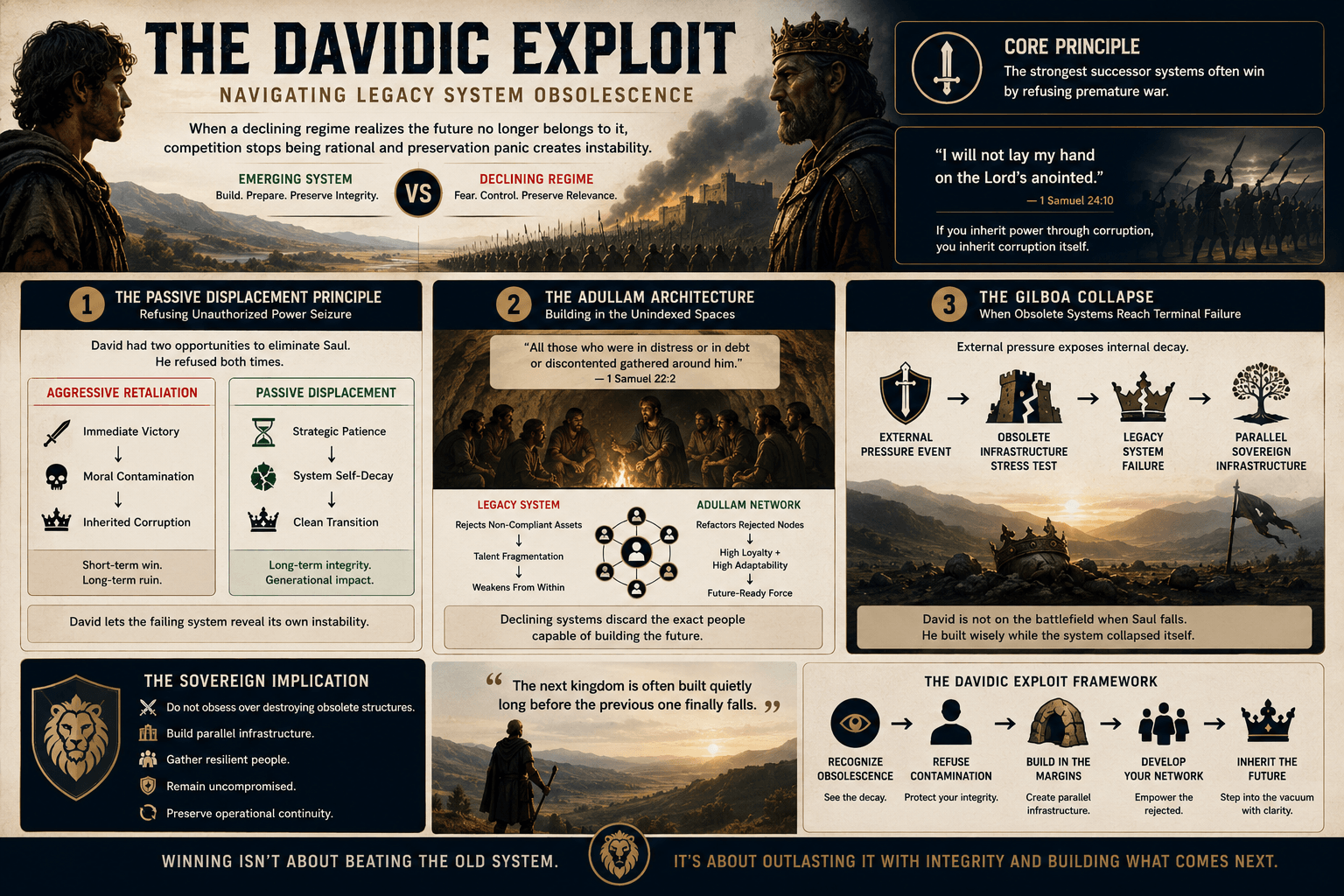
THE DAVIDIC EXPLOIT
The most dangerous moment for an emerging sovereign system is not its beginning.
It is the moment the existing regime realizes:
the future no longer belongs to them.
At that point, competition stops being rational.
A declining institution no longer fights to improve itself.
It fights to preserve relevance.
And preservation panic creates instability.
In 1 Samuel, King Saul becomes the archetype of a collapsing legacy architecture:
- politically fragile,
- psychologically deteriorating,
- strategically reactive,
- and increasingly disconnected from real-time signal awareness.
His operational authority is already decaying internally long before the throne officially changes hands.
But instead of accepting obsolescence, Saul redirects the machinery of the state toward a singular obsession:
Eliminating David.
What follows is not merely a wilderness survival story.
It is a blueprint for surviving aggressive legacy systems without becoming corrupted by them.
The Davidic Exploit reveals a critical principle:
The strongest successor systems often win by refusing premature war.
1. The Passive Displacement Principle
Refusing Unauthorized Power Seizure
Twice, David is handed a perfect opportunity to eliminate Saul directly.
Once inside the cave at En Gedi.
Once inside Saul’s sleeping camp.
Both times, David’s own circle pressures him toward immediate execution.
From a purely tactical perspective, the logic seems obvious:
- remove the threat,
- end the pursuit,
- seize the transition early.
But David refuses.
“I will not lay my hand on the Lord’s anointed.” — 1 Samuel 24:10
This decision defines the entire exploit.
[ Aggressive Retaliation ]
            ↓
Immediate Victory
            ↓
Moral Contamination
            ↓
Inherited Corruption

[ Passive Displacement ]
            ↓
Strategic Patience
            ↓
System Self-Decay
            ↓
Clean Transition
David understands something most successor systems miss:
If you inherit power through corruption, you inherit corruption itself.
Many emerging operators destroy themselves trying to force transition before the environment is ready.
They:
- overreact,
- escalate emotionally,
- mirror toxic tactics,
- or become consumed by revenge loops.
But the Davidic Exploit refuses contamination.
Instead of accelerating collapse artificially, David allows the failing system to reveal its own instability naturally.
That restraint preserves the integrity of the incoming architecture.
2. The Adullam Architecture
Building in the Unindexed Spaces
While Saul burns through state resources hunting shadows across the wilderness, David disappears into the margins of the map.
The Cave of Adullam becomes more than a hiding place.
It becomes a parallel infrastructure layer.
“All those who were in distress or in debt or discontented gathered around him.” — 1 Samuel 22:2
At first glance, these appear to be society’s discarded nodes:
- indebted,
- frustrated,
- displaced,
- politically disconnected.
But David sees something different.
Potential.
[ Legacy System ]
            ↓
Rejects Non-Compliant Assets
            ↓
Talent Fragmentation

[ Adullam Network ]
            ↓
Refactors Rejected Nodes
            ↓
High Loyalty + High Adaptability
This is one of the most important principles in the entire doctrine:
Declining systems often discard the exact people capable of building the future.
Rigid institutions prioritize:
- compliance,
- optics,
- hierarchy,
- and bureaucratic conformity.
But emerging systems thrive on:
- adaptability,
- loyalty,
- resilience,
- and unconventional capability.
David does not waste energy trying to regain approval from Saul’s collapsing court.
He builds an entirely new operational culture outside it.
And over time, the rejected become elite.
The distressed become disciplined.
The fragmented become synchronized.
The cave quietly evolves into the foundation of the next kingdom.
3. The Gilboa Collapse
When Obsolete Systems Reach Terminal Failure
The transition finally arrives through external pressure.
The Philistines launch a major offensive at Mount Gilboa.
Saul enters the conflict already internally fractured:
- disconnected from guidance,
- blinded by fear,
- exhausted by paranoia,
- and strategically isolated.
The collapse becomes inevitable.
[ External Pressure Event ]
            ↓
Obsolete Infrastructure Stress Test
            ↓
Legacy System Failure

[ Parallel Sovereign Infrastructure ]
            ↓
Continuity Preservation
            ↓
Natural Succession
The critical detail is this:
David is nowhere near the battlefield when Saul falls.
He does not engineer the collapse directly.
He does not force the transition manually.
He simply survives long enough — and builds wisely enough — for the failing system to reach its own expiration point.
That distinction matters.
Because successor architectures rarely inherit the future through brute conquest alone.
Most inherit the future because:
- the old structure loses coherence,
- internal instability compounds,
- and no resilient alternative exists except the parallel system quietly built in the shadows.
David does not seize the kingdom violently.
He steps into the vacuum left behind by systemic failure.
The Sovereign Implication
The Davidic Exploit is ultimately about strategic patience during institutional decline.
When legacy systems begin targeting emerging builders:
- creators,
- independent media networks,
- decentralized infrastructures,
- sovereign brands,
- or parallel ecosystems
often make the mistake of escalating too early.
They fight emotionally.
They attack directly.
They become consumed by proving themselves to the old regime.
But the exploit teaches a different principle:
Build while the old system burns itself out.
Do not obsess over destroying obsolete structures.
Most collapsing systems are already carrying the seeds of their own failure:
- internal corruption,
- unsustainable overhead,
- fear-driven leadership,
- and loss of adaptive capacity.
Your responsibility is not to inherit their instability.
Your responsibility is to:
- remain uncompromised,
- build parallel infrastructure,
- gather resilient people,
- and preserve operational continuity for the transition that inevitably follows.
Because when the next major disruption arrives, the future will not belong to the loudest institution.
It will belong to the architecture still standing after the collapse.
That is the principle behind the Davidic Exploit:
