
Distributed Influence Without Centralization
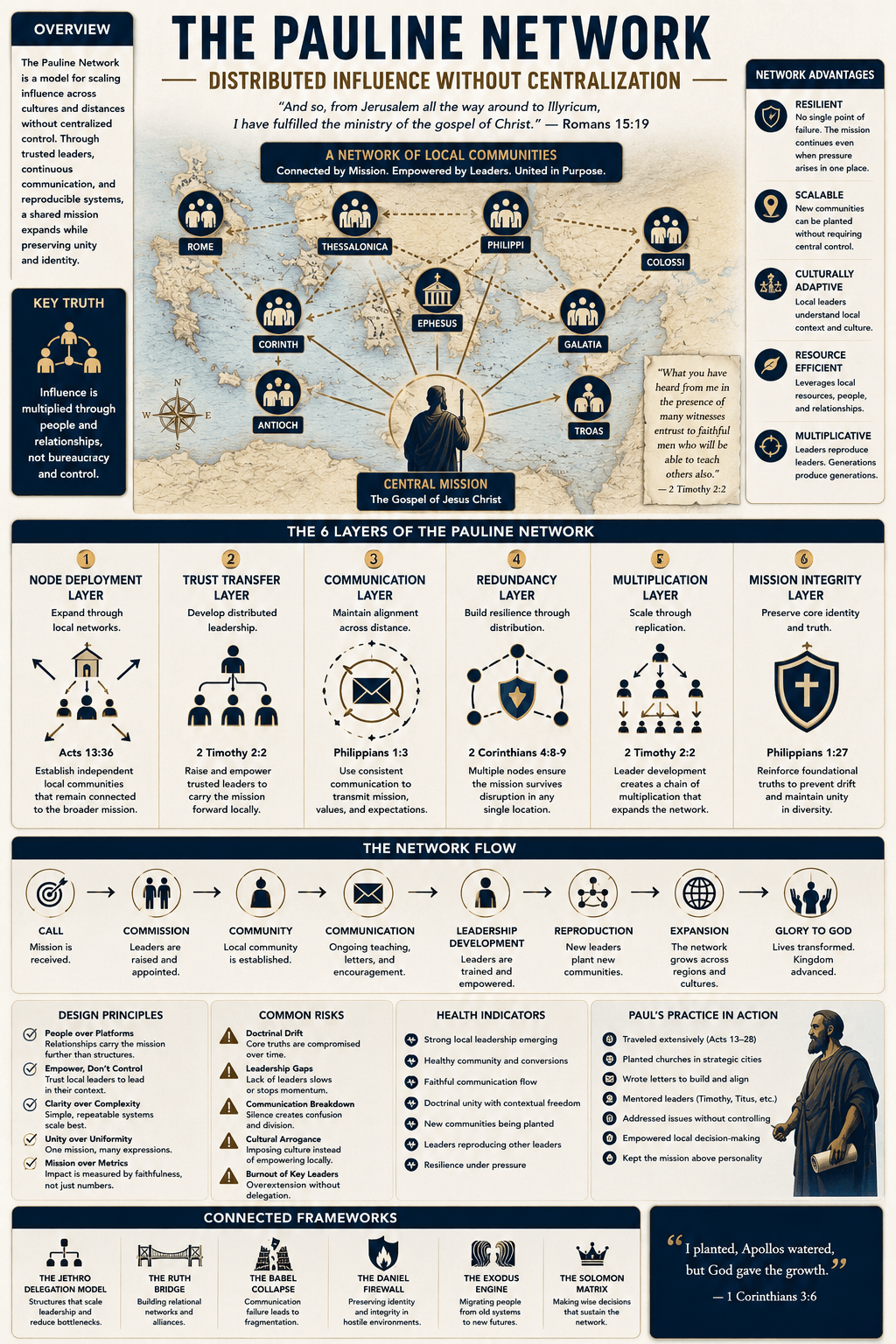
THE PAULINE NETWORK
Most systems assume growth requires centralization.
More offices.
More bureaucracy.
More management layers.
More direct oversight.
Yet history repeatedly demonstrates that some of the most resilient and influential systems grow in the opposite direction.
They expand through networks.
The Apostle Paul faced a challenge unlike any previous biblical leader.
His objective was not to govern a single city.
It was not to manage a single nation.
It was not to maintain a centralized institution.
His objective was to establish a growing movement across multiple regions, cultures, languages, and political environments simultaneously.
Viewed through a systems architecture lens, Paul reveals a framework for scaling influence without centralized control.
The Pauline Network explores how distributed systems maintain alignment, transmit culture, and expand across vast distances while preserving a shared mission.
⸻
- The Node Deployment Layer
Expanding Through Local Networks
Paul rarely attempted to control entire regions directly.
Instead, he established local communities.
“And so, from Jerusalem all the way around to Illyricum, I have fulfilled the ministry of the gospel of Christ.” — Romans 15:19
Rather than creating one massive centralized organization, he deployed independent nodes.
Central Mission
↓
Local Communities
↓
Regional Expansion
Each node retained local presence while remaining connected to the broader network.
⸻
- The Trust Transfer Layer
Developing Distributed Leadership
The Pauline Network depends heavily upon trusted operators.
Timothy.
Titus.
Silas.
Priscilla.
Aquila.
And many others.
Paul consistently delegated responsibility.
“What you have heard from me in the presence of many witnesses entrust to faithful men.” — 2 Timothy 2:2
Mission
↓
Trusted Leaders
↓
Local Execution
This allows expansion without requiring direct oversight of every operation.
⸻
- The Communication Layer
Maintaining Alignment Across Distance
Distance creates risk.
Information degrades.
Interpretations diverge.
Cultures drift.
Paul addresses this through continuous communication.
His letters function as alignment infrastructure.
“I thank my God in all my remembrance of you.” — Philippians 1:3
Distributed Nodes
↓
Communication Network
↓
Shared Understanding
The network remains connected through consistent transmission of mission, values, and expectations.
⸻
- The Redundancy Layer
Resilience Through Distribution
A centralized system often contains a single point of failure.
Distributed systems do not.
If one city encounters opposition, the mission continues elsewhere.
If one leader falls away, others remain active.
Single Hub Failure
↓
System Collapse
Distributed Nodes
↓
Network Survival
This creates extraordinary resilience.
The movement does not depend on a single location.
⸻
- The Multiplication Layer
Scaling Through Replication
The objective is not merely preservation.
It is multiplication.
Paul instructs Timothy:
“Entrust to faithful men who will be able to teach others also.” — 2 Timothy 2:2
Notice the pattern.
Paul
↓
Timothy
↓
Faithful Leaders
↓
Others
The network expands through replication rather than direct control.
Each generation becomes capable of producing the next.
⸻
- The Mission Integrity Layer
Preserving Core Identity
The challenge facing every distributed system is drift.
As expansion occurs, local variations emerge.
Without shared principles, fragmentation follows.
Paul repeatedly returns to foundational truths.
“Only let your manner of life be worthy of the gospel.” — Philippians 1:27
Expansion
↓
Variation Risk
↓
Mission Reinforcement
↓
Network Stability
Growth remains sustainable because identity remains clear.
⸻
The Sovereign Implication
The Pauline Network reveals that influence does not require centralization.
Many leaders assume growth demands greater control.
Paul demonstrates a different model.
One built upon:
- trusted operators,
- local execution,
- continuous communication,
- distributed resilience,
- leadership multiplication,
- and shared mission alignment.
For builders, organizations, media networks, movements, and sovereign operators, the lesson remains timeless:
- develop leaders rather than dependencies,
- communicate values continuously,
- distribute authority responsibly,
- eliminate single points of failure,
- and build systems capable of reproducing themselves.
Because sustainable influence rarely expands through control alone.
It expands through networks.
That is the principle behind the Pauline Network:
The strongest movements are not those controlled from a single center.
They are the movements that can scale while remaining aligned.
