
Communication Failure and System Fragmentation
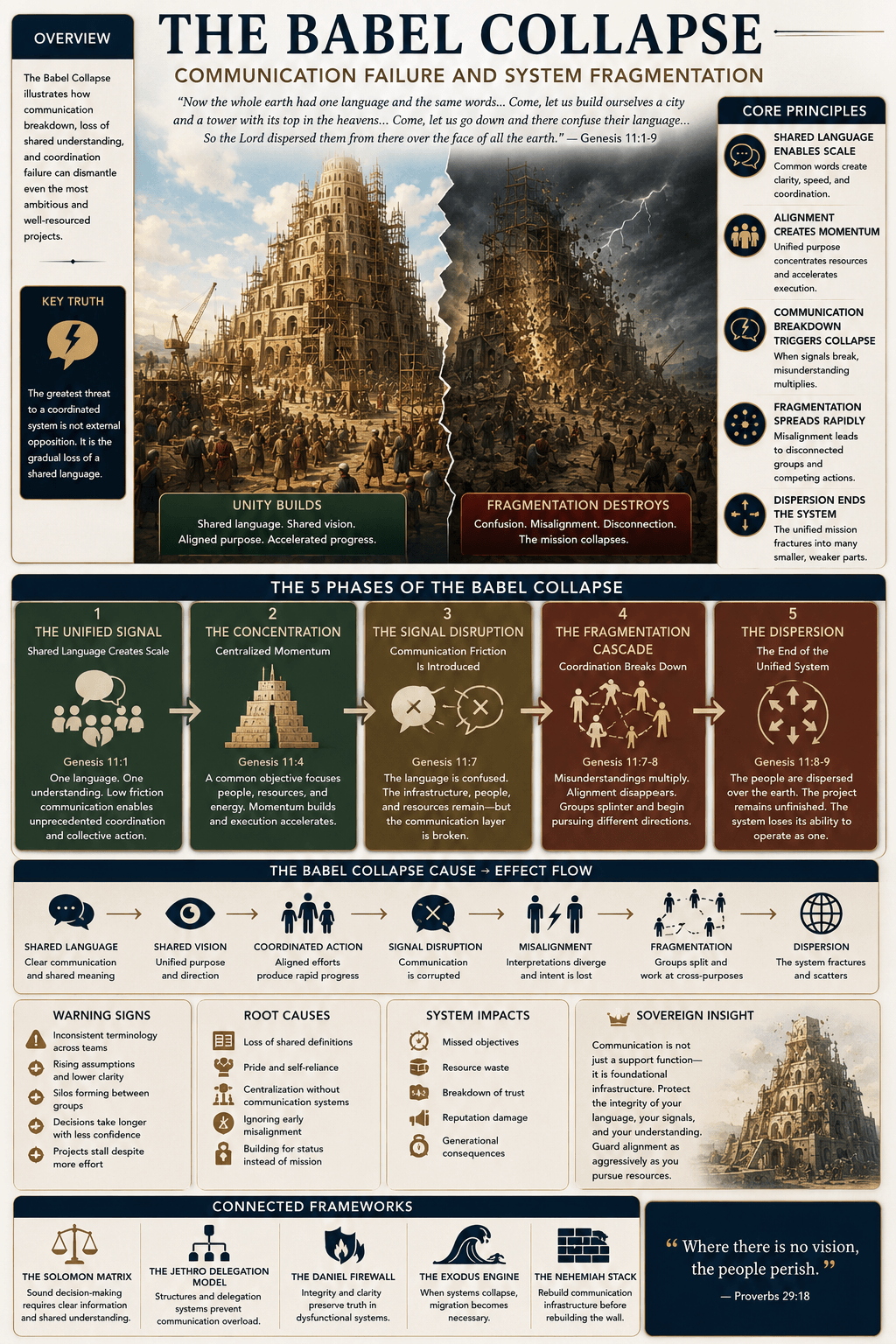
THE BABEL COLLAPSE
Communication Failure and System Fragmentatio.
Most systems do not collapse because of insufficient resources.
They collapse because coordination fails.
A shared mission becomes fragmented.
Signals become distorted.
Assumptions multiply.
Alignment deteriorates.
And eventually the system loses the ability to move as a unified whole.
The account of the Tower of Babel records one of history’s earliest large-scale coordination failures.
Humanity possessed:
- a shared objective,
- a common language,
- a concentrated workforce,
- and a unified operational direction.
On paper, the project appeared unstoppable.
Yet despite unprecedented alignment, the initiative abruptly disintegrated.
The workers dispersed.
The mission collapsed.
The structure remained unfinished.
Viewed through a systems architecture lens, Babel reveals a framework for understanding how communication breakdowns trigger fragmentation inside otherwise capable systems.
The Babel Collapse explores how coordination failure, signal degradation, and loss of shared understanding can dismantle even the most ambitious projects.
⸻
- The Unified Signal Layer
Shared Language Creates Scale
The narrative begins with extraordinary alignment.
“Now the whole earth had one language and the same words.” — Genesis 11:1
Communication friction was minimal.
Coordination costs were low.
Information moved efficiently.
Shared Language
↓
Shared Understanding
↓
Coordinated Action
↓
Rapid Scale
Every large system depends upon this layer.
Without shared understanding, collective action becomes difficult.
⸻
- The Concentration Layer
Centralized Momentum
The builders develop a common objective.
“Come, let us build ourselves a city and a tower.” — Genesis 11:4
Their focus creates enormous momentum.
Resources converge.
Labor concentrates.
Execution accelerates.
Common Objective
↓
Resource Concentration
↓
Execution Velocity
Large-scale systems often emerge through this process.
Alignment produces growth.
⸻
- The Signal Disruption Event
Introducing Communication Friction
The turning point occurs suddenly.
“Come, let us go down and there confuse their language.” — Genesis 11:7
The disruption is not physical.
Infrastructure remains.
Workers remain.
Resources remain.
The communication layer changes.
Infrastructure
Remains
Personnel
Remain
Resources
Remain
Communication
Fails
This distinction is critical.
The collapse begins long before the structure itself falls.
⸻
- The Fragmentation Cascade
When Coordination Breaks Down
Once communication deteriorates, synchronization disappears.
Tasks become disconnected.
Intent becomes unclear.
Groups begin operating independently.
Signal Loss
↓
Misalignment
↓
Coordination Failure
↓
Fragmentation
The project becomes increasingly difficult to manage.
Not because the builders lose capability.
Because they lose coherence.
⸻
- The Dispersion Layer
The End of the Unified System
The final outcome is predictable.
“So the Lord dispersed them from there over the face of all the earth.” — Genesis 11:8
The centralized system dissolves into multiple smaller systems.
Unified System
↓
Communication Failure
↓
Fragmentation
↓
Distributed Systems
The tower remains incomplete.
The network loses its ability to operate as a single coordinated entity.
⸻
The Sovereign Implication
The Babel Collapse reveals that communication is not merely a support function.
It is foundational infrastructure.
Organizations, movements, governments, communities, and enterprises often focus on:
- funding,
- personnel,
- technology,
- and strategy.
Yet many failures originate elsewhere.
They begin when shared understanding deteriorates.
For leaders, builders, and system architects, the lesson remains timeless:
- preserve communication integrity,
- maintain shared definitions,
- reduce signal distortion,
- monitor coordination friction,
- and protect alignment as aggressively as resources.
Because systems rarely fail the moment communication breaks.
They fail shortly afterward.
That is the principle behind the Babel Collapse:
The greatest threat to a coordinated system is not external opposition.
It is the gradual loss of a shared language.
