
Large-Scale System Migration
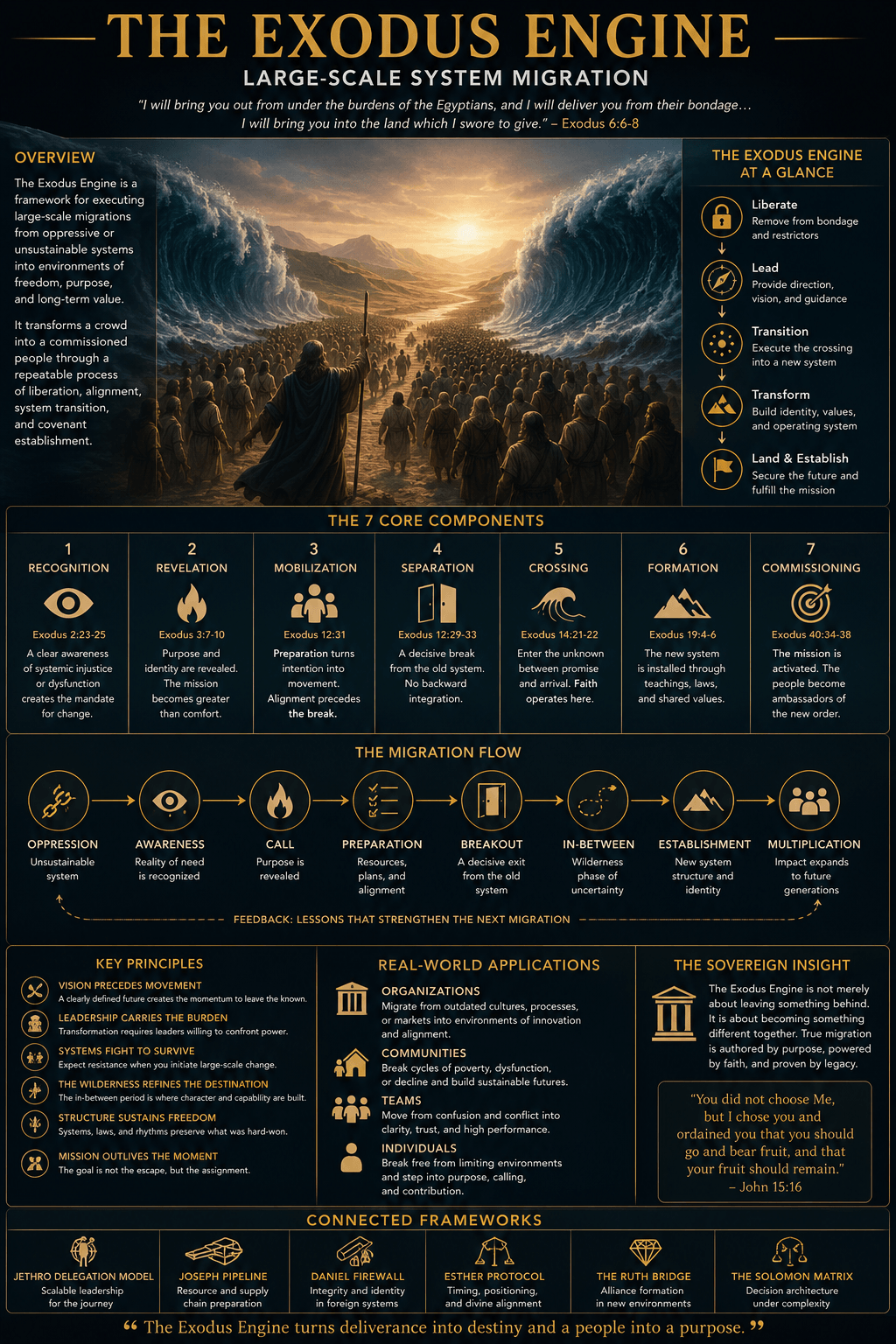
THE EXODUS ENGINE
Most systems are not destroyed.
They are abandoned.
Not because they immediately collapse, but because they eventually become incapable of supporting the future.
The challenge facing every generation is determining when a system has become so restrictive, inefficient, or misaligned that remaining inside it becomes more dangerous than leaving.
The Book of Exodus records one of the largest and most consequential migrations in history.
For centuries, the Israelites existed inside the Egyptian system.
At first, Egypt functioned as a refuge.
Over time, it evolved into a structure of dependency, control, and forced labor.
What began as a survival platform became a constraint on future growth.
Exodus is often remembered as a story of liberation.
But viewed through a systems architecture lens, it reveals something even deeper:
A Framework for Large-Scale System Migration
The Exodus Engine explores how people, organizations, and entire communities successfully transition from a declining or oppressive system into a new operating environment without collapsing during the process.
1. The Recognition Layer
Identifying System Failure
Before migration can occur, the problem must be acknowledged.
The Israelites had adapted to life inside Egypt.
Many had never known another environment.
Yet the system itself had become increasingly hostile.
“The Israelites groaned in their slavery and cried out.” — Exodus 2:23
System Stability
        ↓
Increasing Burden
        ↓
Loss of Freedom
        ↓
Recognition Event
Every migration begins with awareness.
People rarely leave systems they still believe are working.
2. The Leadership Activation Layer
Mobilizing the Transition
A migration requires more than dissatisfaction.
It requires direction.
God commissions Moses with a clear mandate:
“Come, I will send you to Pharaoh that you may bring my people, the children of Israel, out of Egypt.” — Exodus 3:10
This moment transforms frustration into movement.
Problem Awareness
        ↓
Mission Definition
        ↓
Leadership Activation
        ↓
Collective Movement
Without leadership, dissatisfaction remains stagnant.
Without vision, migration never begins.
3. The Decoupling Phase
Breaking Dependency on the Legacy System
One of the most difficult aspects of migration is separation.
Legacy systems rarely release resources willingly.
Pharaoh repeatedly resists.
The conflict reveals an important principle:
Systems built on dependency resist transition.
“Who is the Lord, that I should obey his voice and let Israel go?” — Exodus 5:2
Legacy System
        ↓
Dependency
        ↓
Resistance
        ↓
Separation Event
Before a new future can emerge, old dependencies must be broken.
4. The Crossing Event
Entering the Point of No Return
The crossing of the Red Sea represents the most dramatic moment in the migration.
The old system remains behind.
The new system has not yet fully emerged.
The people exist between worlds.
“The Lord drove the sea back by a strong east wind all night.” — Exodus 14:21
Old System
      ↓
Transition Zone
      ↓
Point of No Return
      ↓
New Environment
Every major migration contains this stage.
The familiar has been left behind.
The destination remains uncertain.
Yet forward movement is the only viable option.
5. The Wilderness Layer
Rebuilding the Operating System
Most people assume the migration ends after liberation.
Exodus reveals the opposite.
The most difficult work begins afterward.
The wilderness becomes a reconstruction environment.
Identity must be rebuilt.
Governance must be established.
Culture must be defined.
Systems must be installed.
“Now therefore, if you will indeed obey my voice and keep my covenant…” — Exodus 19:5
Liberation
      ↓
Formation
      ↓
Governance
      ↓
Culture
      ↓
New System
Freedom without structure produces instability.
The wilderness transforms a population into a nation.
6. The Continuity Layer
Preserving the Mission Beyond the Migration
The ultimate objective was never merely escaping Egypt.
The objective was establishing a sustainable future.
Migration without destination creates wandering.
Migration with purpose creates continuity.
Escape
      ↓
Transition
      ↓
Formation
      ↓
Mission
      ↓
Continuity
The Exodus Engine succeeds because it does not merely remove people from an old system.
It prepares them to operate inside a new one.
The Sovereign Implication
The Exodus Engine reveals that successful migrations require more than dissatisfaction with the present.
They require:
- recognition of systemic failure,
- leadership capable of mobilizing change,
- separation from unhealthy dependencies,
- courage during transitional uncertainty,
- reconstruction of culture and governance,
- and commitment to a long-term mission.
For leaders, organizations, builders, and sovereign operators, the lesson remains timeless:
- recognize when a system has become restrictive,
- define a clear destination before initiating movement,
- expect resistance from legacy structures,
- prepare for uncertainty during transition,
- and understand that rebuilding is often harder than escaping.
Because the greatest challenge is not leaving the old system.
It is successfully constructing the new one.
That is the principle behind the Exodus Engine:
