
Strategic Alliance Formation and Cross-Boundary Integration
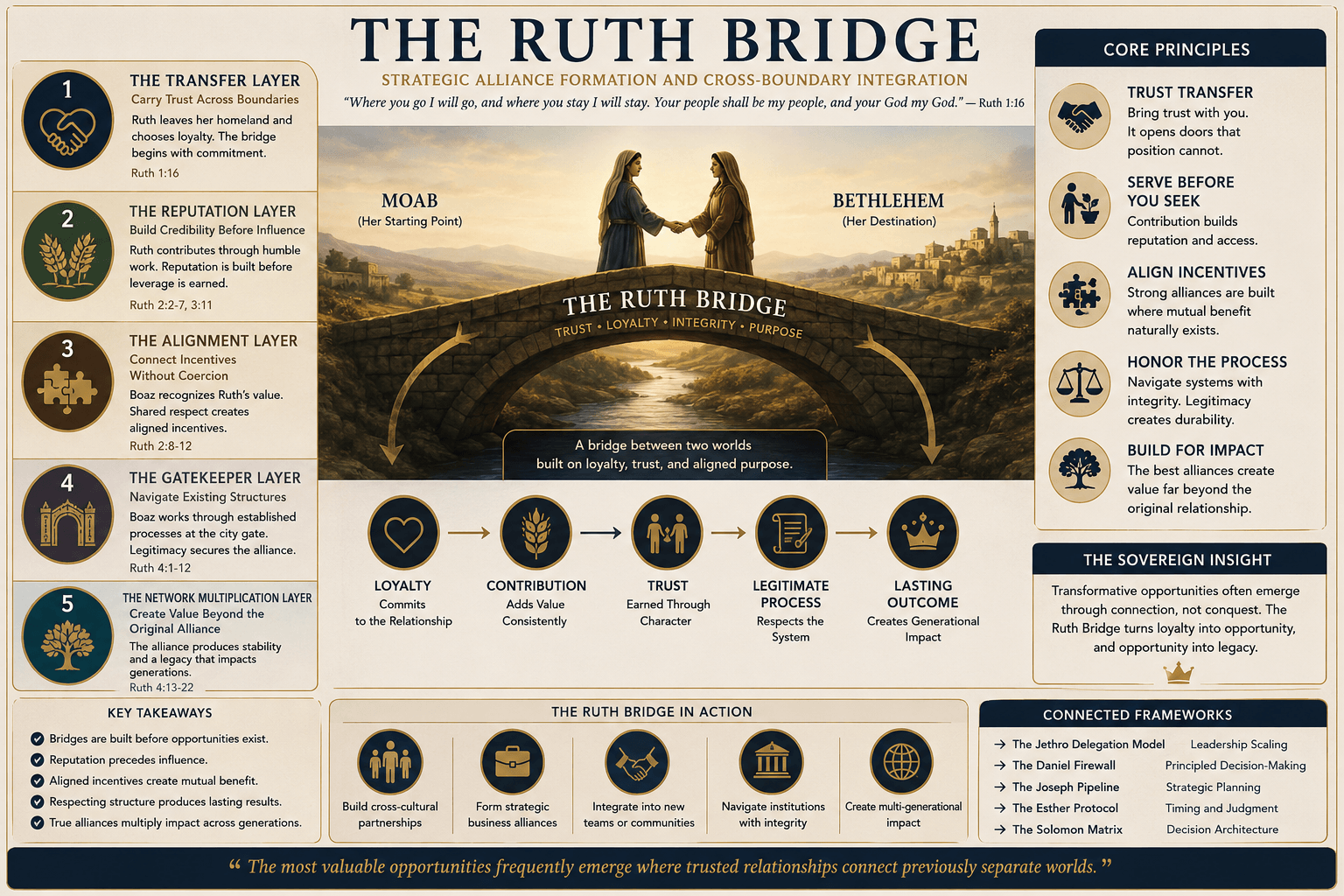
THE RUTH BRIDGE
Most systems focus on expansion.
More resources.
More influence.
More infrastructure.
More scale.
Yet some of the most transformative developments in history emerge not through expansion, but through connection.
The ability to build bridges between separate networks often creates opportunities that brute force, wealth, or authority alone cannot achieve.
The Book of Ruth presents one of Scripture’s most remarkable alliance formation narratives.
At first glance, the story appears simple:
A widow leaves her homeland and accompanies her mother-in-law into an unfamiliar society.
But beneath the surface lies a sophisticated framework involving loyalty, trust transfer, reputation, integration, and strategic relationship building.
Ruth enters Bethlehem with almost no leverage:
- no political authority,
- no institutional position,
- no local network,
- no inherited assets.
Yet by the end of the narrative she becomes integrated into the community, secures long-term stability, and ultimately enters the lineage of King David.
Viewed through a systems architecture lens, Ruth reveals a framework for:
Strategic Alliance Formation
The Ruth Bridge explores how trust, loyalty, and aligned incentives create durable connections between previously disconnected systems.
1. The Transfer Layer
Carrying Trust Across Boundaries
Following the deaths of their husbands, Naomi urges Ruth to remain in Moab.
Instead, Ruth makes a decision that changes the trajectory of both their futures.
“Where you go I will go, and where you stay I will stay. Your people shall be my people, and your God my God.” — Ruth 1:16
This statement represents more than personal loyalty.
It represents a transfer event.
Moab Network
        ↓
Trust Transfer
        ↓
Bethlehem Network
Ruth voluntarily exits a familiar system and enters a new one through relational trust rather than formal authority.
The bridge begins before any opportunity exists.
It begins with commitment.
2. The Reputation Layer
Building Credibility Before Influence
Upon arriving in Bethlehem, Ruth does not seek immediate status.
She enters the fields to glean.
She contributes before she negotiates.
She serves before she influences.
Boaz later observes:
“All my fellow townsmen know that you are a worthy woman.” — Ruth 3:11
Contribution
        ↓
Reputation
        ↓
Trust
        ↓
Opportunity
The Ruth Bridge demonstrates a critical principle:
Sustainable alliances are built on credibility before leverage.
Many systems attempt to negotiate influence before earning trust.
Ruth reverses the sequence.
3. The Alignment Layer
Connecting Incentives Without Coercion
Boaz becomes aware of Ruth’s circumstances.
Yet the relationship does not develop through manipulation or pressure.
Instead, both parties operate within an existing framework of mutual benefit and shared responsibility.
Boaz tells Ruth:
“Remain here with my young women.” — Ruth 2:8
And later:
“The Lord repay you for what you have done.” — Ruth 2:12
Shared Interests
        ↓
Mutual Respect
        ↓
Aligned Incentives
        ↓
Alliance Formation
The strongest bridges are not constructed through force.
They emerge when incentives naturally align.
4. The Gatekeeper Layer
Navigating Existing Structures
Before the alliance can fully materialize, a legal obstacle remains.
Another redeemer possesses a stronger claim.
Boaz does not bypass the system.
He works through it.
At the city gate he presents the matter publicly.
“You are witnesses this day.” — Ruth 4:9
Opportunity
        ↓
Institutional Process
        ↓
Legitimate Integration
This is a critical feature of the framework.
The Ruth Bridge does not destroy existing structures.
It navigates them successfully.
5. The Network Multiplication Layer
Creating Value Beyond the Original Alliance
The story concludes with far more than individual stability.
A larger network effect emerges.
Ruth and Boaz become the grandparents of King David.
“Boaz fathered Obed, Obed fathered Jesse, and Jesse fathered David.” — Ruth 4:22
Alliance
        ↓
Integration
        ↓
Stability
        ↓
Generational Expansion
What began as a relationship between two vulnerable individuals becomes a node in a much larger historical architecture.
The bridge produces outcomes neither party could have achieved independently.
The Sovereign Implication
The Ruth Bridge reveals that transformative opportunities often emerge through connection rather than conquest.
Many systems focus exclusively on growth.
Few focus on integration.
Yet durable alliances are built through:
- trust,
- contribution,
- aligned incentives,
- credibility,
- and respect for existing structures.
For leaders, builders, organizations, and sovereign operators, the lesson remains timeless:
- carry trust across boundaries,
- contribute before seeking influence,
- align incentives before pursuing agreements,
- navigate systems rather than bypass them,
- and build bridges capable of creating value beyond the original relationship.
Because the strongest networks are not always the largest.
They are often the most connected.
That is the principle behind the Ruth Bridge:
