
Decision Architecture Under Complexity
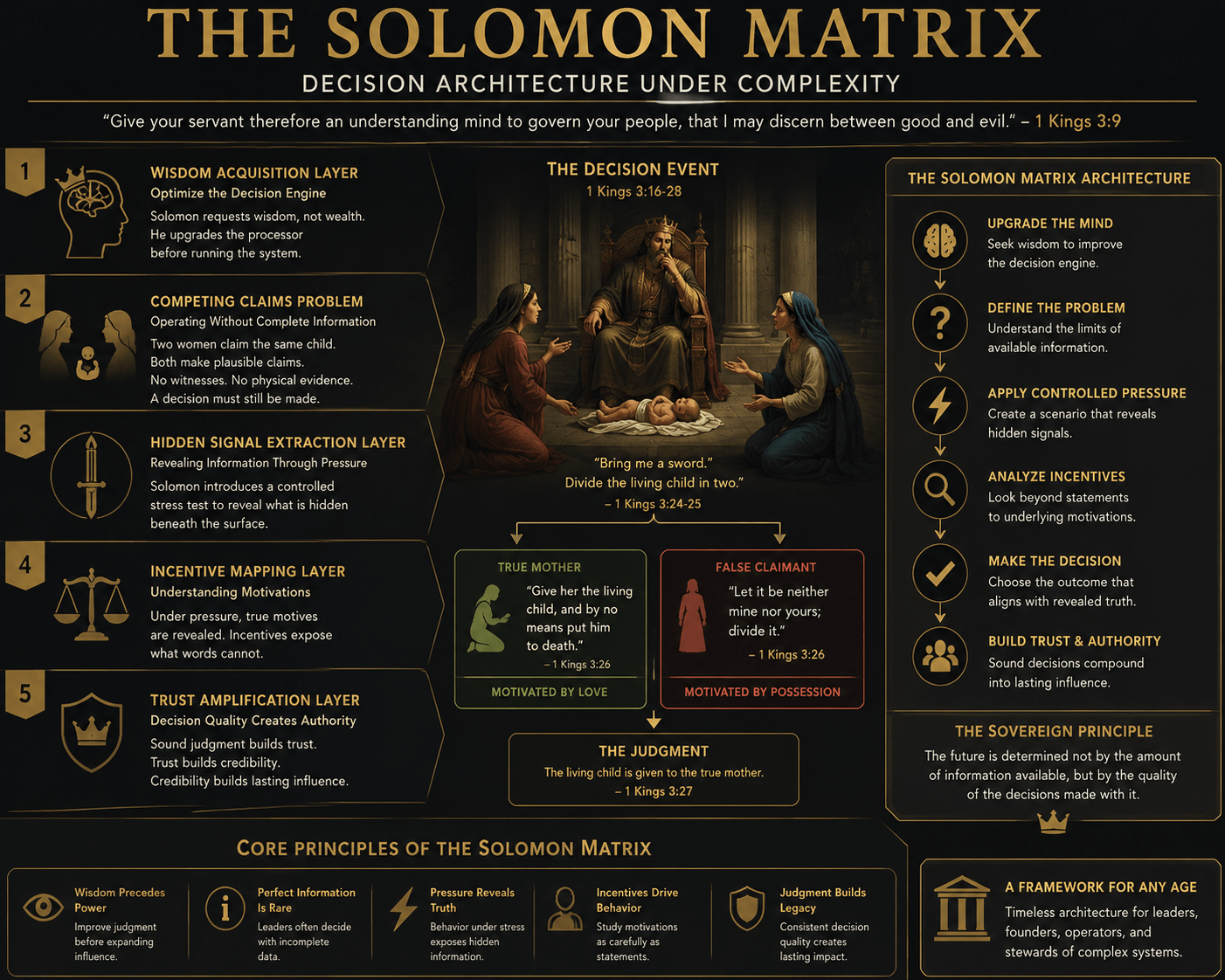
THE SOLOMON MATRIX
Most systems do not fail because of insufficient information.
They fail because they cannot correctly interpret the information they already possess.
Data increases.
Variables multiply.
Stakeholders compete.
Pressure intensifies.
And eventually leaders encounter a familiar problem:
Multiple plausible decisions exist, but only one produces the desired outcome.
The challenge is no longer information acquisition.
The challenge becomes judgment.
The Book of 1 Kings introduces one of the most famous decision-making events in human history.
Shortly after assuming the throne, Solomon receives an extraordinary offer.
“Ask what I shall give you.” — 1 Kings 3:5
Rather than requesting wealth, military power, or political dominance, Solomon asks for something else entirely:
“Give your servant therefore an understanding mind to govern your people, that I may discern between good and evil.” — 1 Kings 3:9
The request is significant.
Because leadership at scale is fundamentally a decision-making problem.
Viewed through a systems architecture lens, Solomon reveals a framework for:
Decision Architecture Under Complexity
The Solomon Matrix explores how leaders navigate uncertainty, competing claims, incomplete information, and high-stakes judgment.
1. The Wisdom Acquisition Layer
Optimizing the Decision Engine
Before Solomon solves complex problems, he upgrades the processor itself.
Most operators focus on acquiring:
- resources,
- authority,
- personnel,
- infrastructure.
Solomon focuses on judgment.
“Behold, I give you a wise and discerning mind.” — 1 Kings 3:12
Resources
      ↓
Better Execution

Wisdom
      ↓
Better Decisions
      ↓
Better Outcomes
The framework begins with a foundational principle:
The quality of a system’s decisions determines the quality of its future.
2. The Competing Claims Problem
Operating Without Complete Information
Immediately following Solomon’s request, the narrative presents a difficult case.
Two women appear before the king.
Both claim the same child.
Both provide plausible testimony.
No witnesses exist.
No physical evidence exists.
No objective verification exists.
Claim A
      ↓

Insufficient Evidence

      ↑
Claim B
This is where many systems stall.
Information is incomplete.
Yet a decision must still be made.
The Solomon Matrix recognizes a critical reality:
Leaders rarely receive perfect information before action becomes necessary.
3. The Hidden Signal Extraction Layer
Revealing Information Through Pressure
Rather than choosing randomly, Solomon creates a controlled stress test.
“Bring me a sword.” — 1 Kings 3:24
The proposal shocks the room:
“Divide the living child in two.” — 1 Kings 3:25
The instruction is not the solution.
It is the diagnostic mechanism.
Controlled Pressure
         ↓
Behavioral Response
         ↓
Hidden Information Revealed
The true mother immediately responds:
“Give her the living child, and by no means put him to death.” — 1 Kings 3:26
The competing claimant does not.
The pressure reveals information unavailable through direct questioning.
4. The Incentive Mapping Layer
Understanding Motivations
The brilliance of the matrix lies in recognizing that people reveal priorities when placed under stress.
Under ordinary circumstances:
Statements
Can Be Manipulated
Under pressure:
Incentives
Become Visible
Solomon does not merely analyze testimony.
He analyzes motivations.
This distinction becomes one of the most powerful decision-making principles in the framework:
When information is unclear, examine incentives.
Behavior often reveals what words conceal.
5. The Trust Amplification Layer
Decision Quality Creates Authority
The aftermath is important.
“And all Israel heard of the judgment that the king had rendered, and they stood in awe of the king.” — 1 Kings 3:28
Why?
Because credibility compounds through demonstrated judgment.
Sound Decisions
        ↓
Trust
        ↓
Credibility
        ↓
Influence
Authority alone does not create trust.
Consistently correct decisions do.
The Sovereign Implication
The Solomon Matrix reveals that leadership is ultimately a decision-making discipline.
Resources matter.
Infrastructure matters.
Authority matters.
But none of them compensate for poor judgment.
For leaders, builders, organizations, and sovereign operators, the lesson remains timeless:
- improve the decision engine before expanding the system,
- recognize that perfect information is rare,
- use pressure to reveal hidden signals,
- study incentives as carefully as statements,
- and understand that trust compounds through sound judgment.
Because the future is often determined not by the amount of information available.
But by the quality of the decisions made with it.
That is the principle behind the Solomon Matrix:
The most powerful systems are not those with the most data.
They are the systems capable of extracting wisdom from uncertainty.
Continue Exploring the Framework Library:
→ The Jethro Delegation Model
Discover how effective leaders scale decision-making by distributing authority, reducing bottlenecks, and building sustainable organizational structures.
→ The Daniel Firewall
Explore how conviction, integrity, and clearly defined boundaries protect sound judgment inside environments that reward compromise.
→ The Joseph Pipeline
Learn how strategic foresight, resource stewardship, and long-term planning transform information into resilience during periods of uncertainty.
→ The Esther Protocol
Examine how timing, positioning, and carefully executed intervention can alter the trajectory of an entire system.
