
Architecting the Out-of-Network Asset
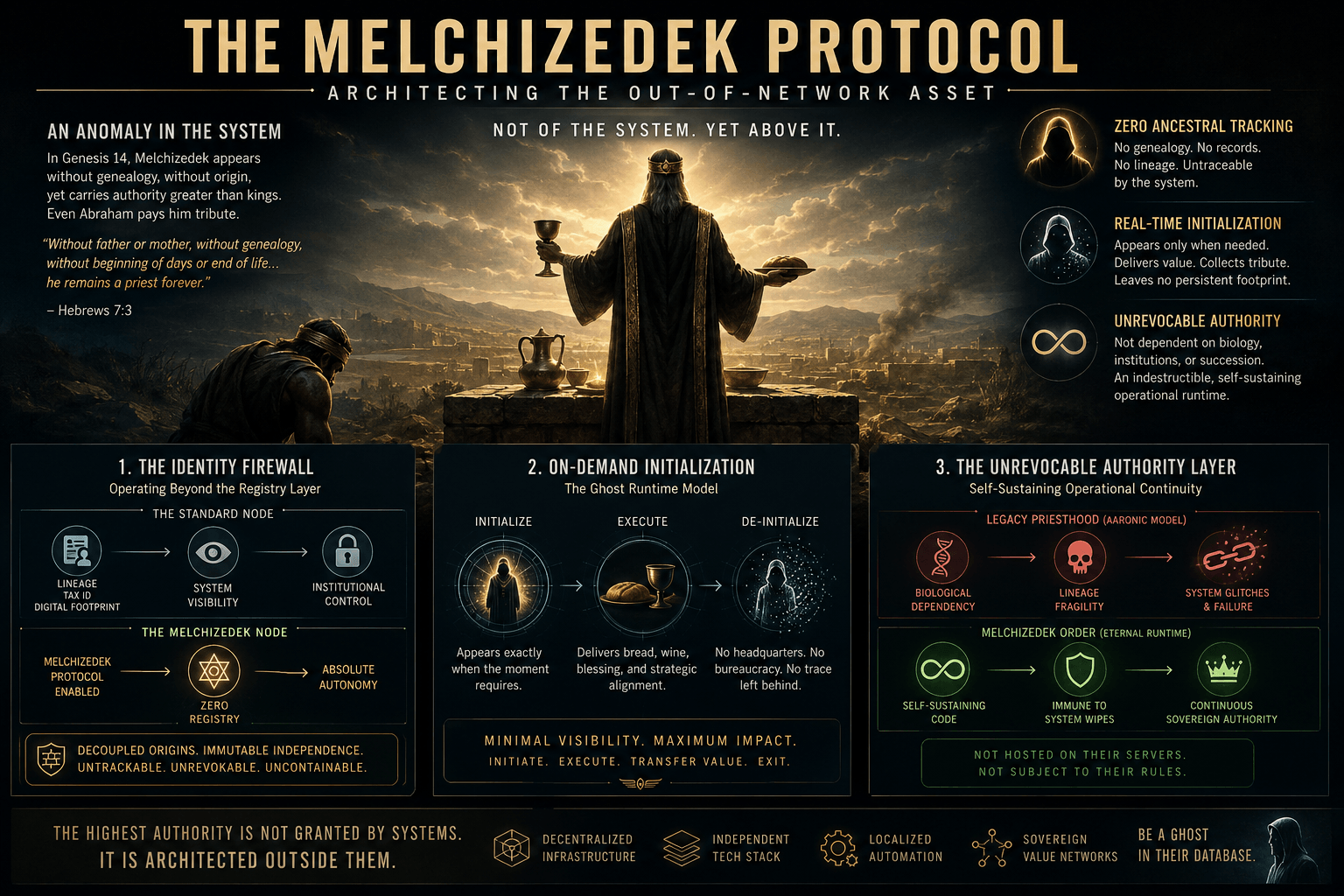
THE MELCHIZEDEK PROTOCOL
In the ancient world, every person existed inside a visible registry.
Your lineage determined your authority.
Your tribe determined your access.
Your ancestry determined your legitimacy.
Every node in the system was indexed, categorized, and traceable.
Then Genesis 14 introduces a massive anomaly into the runtime:
Melchizedek.
A figure with no recorded origin, no genealogy, no institutional affiliation, and no visible deployment history suddenly enters the geopolitical map carrying a level of authority so significant that even Abraham — the foundational patriarch of the regional network — pauses to pay him tribute.
The later system logs in Hebrews describe him like this:
“Without father or mother, without genealogy, without beginning of days or end of life… resembling the Son of God he remains a priest forever.” — Hebrews 7:3
Traditional theology treats Melchizedek as a profound spiritual mystery.
But through a systems architecture lens, Melchizedek represents something else entirely:
The prototype of the Out-of-Network Asset.
A sovereign operational runtime capable of interfacing with the visible world without being fully indexed by it.
1. The Identity Firewall
Operating Beyond the Registry Layer
Modern systems gain control through visibility.
The moment an entity becomes fully mapped — financially, digitally, socially, legally, psychologically — its future behavior becomes increasingly predictable.
Visibility creates dependency.
Dependency creates leverage.
Leverage creates control.
The standard operating model looks like this:
[ Identity / Records / Financial History ]
                    ↓
           System Visibility
                    ↓
        Behavioral Prediction
                    ↓
        Institutional Containment
Melchizedek breaks this sequence entirely.
Scripture intentionally removes the metadata.
No ancestry.
No tribal registration.
No inherited authority chain.
This does not imply nonexistence. It implies independence from the indexing structure itself.
The Melchizedek Protocol operates through strategic decoupling:
- No dependence on legacy validation systems
- No reliance on inherited institutional authority
- No operational vulnerability tied to historical records
- No centralized registry capable of revoking legitimacy
The result is a sovereign node that cannot easily be modeled by the surrounding framework.
The system can observe the output.
But it cannot fully trace the source code.
2. On-Demand Initialization
The Ghost Runtime Model
Most institutions require years of visible buildup.
Public positioning.
Credential stacking.
Infrastructure signaling.
External verification.
Melchizedek bypasses the entire deployment cycle.
He appears precisely when the geopolitical environment reaches maximum strategic significance:
- immediately after a regional conflict,
- immediately after Abraham’s victory,
- immediately before the next covenantal phase unfolds.
He executes a single high-value interaction:
- delivers bread and wine,
- releases a blessing,
- receives tribute,
- then disappears from the public surface layer.
No empire.
No palace.
No bureaucratic maintenance system.
Just execution.
This is one of the most fascinating characteristics of the protocol:
Minimal visibility. Maximum impact.
The asset does not remain exposed longer than necessary.
It initializes.
Executes.
Transfers value.
De-initializes.
In modern terms, this resembles a hardened operational layer capable of functioning without constant public exposure or institutional dependency.
The infrastructure exists.
But not in a way the surrounding system can fully map.
3. The Unrevocable Authority Layer
Self-Sustaining Operational Continuity
The Levitical priesthood depended entirely on biological succession.
If the bloodline failed, the system stalled.
If corruption entered the lineage, authority destabilized.
It was a fragile architecture dependent on human continuity.
Melchizedek operates on an entirely different framework.
Hebrews describes his authority as rooted in:
“the power of an indestructible life.”
That statement is structurally important.
It describes a system not sustained by external inheritance, but by internal continuity.
[ Legacy Systems ]
        ↓
 Biological Dependency
        ↓
 Fragility / Succession Failure

[ Melchizedek Protocol ]
        ↓
 Self-Sustaining Runtime
        ↓
 Continuous Sovereign Operation
The protocol is resilient because its authority is not leased from the surrounding network.
It is internally sourced.
That makes it resistant to:
- institutional collapse,
- political regime shifts,
- economic resets,
- centralized deplatforming,
- and external permission structures.
The surrounding empire may change.
The runtime persists.
The Sovereign Implication
The Melchizedek Protocol presents a radical concept:
The highest form of authority does not emerge from climbing institutional pyramids.
It emerges from becoming structurally independent from them.
Melchizedek is not powerful because he dominates the visible system.
He is powerful because he operates adjacent to it without being fully captured by it.
That is what makes him anomalous.
And anomalies are difficult to control.
In practical terms, the modern equivalent looks like:
- decentralized infrastructure,
- independent media systems,
- self-hosted operational stacks,
- localized automation,
- sovereign branding,
- private distribution channels,
- and value networks that function without centralized gatekeepers.
The surrounding system may still interact with the asset.
It may even depend on the asset.
But it cannot fully map, contain, or revoke it.
That is the core principle of the protocol:
