
Predictive Resource Management and Crisis-Era Continuity
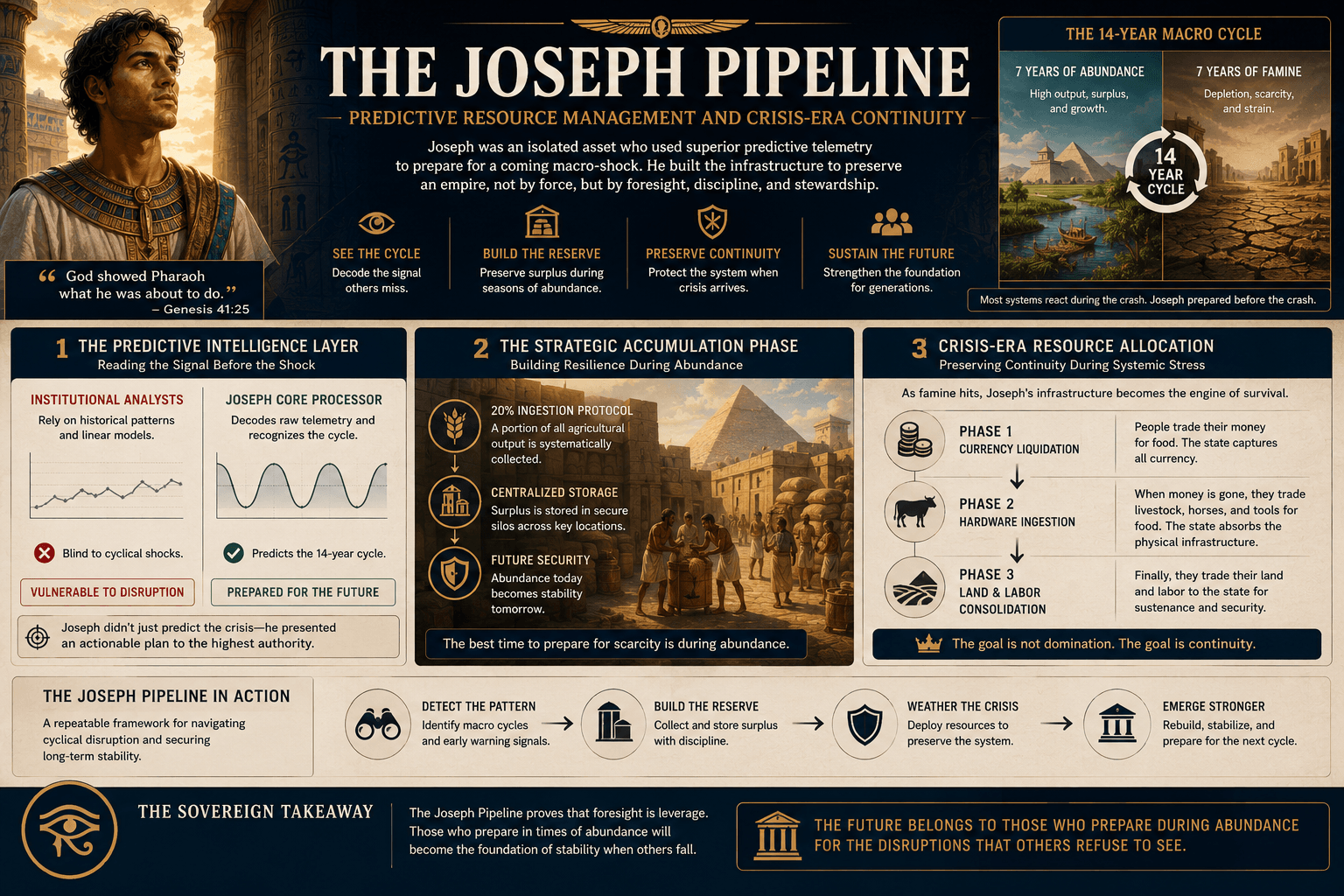
THE JOSEPH PIPELINE
Most systems fail long before the crisis arrives.
The collapse itself is often only the visible symptom.
The real failure occurs during the years of abundance, when institutions mistake favorable conditions for permanent stability.
They optimize for the present.
They consume surplus.
They assume continuity.
And when the cycle changes, they discover that prosperity concealed structural fragility.
The Joseph narrative presents one of history’s most remarkable examples of predictive resource management operating at civilizational scale.
Stripped of position, disconnected from his homeland, and confined within Egypt’s prison system, Joseph appears to possess no meaningful leverage.
Yet within a single transition event, he becomes the chief administrator of the most powerful empire in the region.
Traditional interpretations emphasize providence and personal character.
But viewed through a systems architecture lens, the Joseph Pipeline reveals something equally significant:
The strategic advantage of anticipating cyclical disruption before the surrounding system recognizes it.
Joseph does not overthrow Egypt.
He helps Egypt survive a crisis that would have otherwise destabilized the entire region.
The framework is built upon three interconnected principles:
- predictive pattern recognition,
- disciplined resource accumulation,
- and continuity preservation during systemic stress.
1. The Predictive Intelligence Layer
Reading the Signal Before the Shock
Pharaoh’s dream presents a sequence that confounds the empire’s established experts:
Seven healthy cows.
Seven gaunt cows.
Seven thriving years.
Seven years of famine.
The institutional analysts cannot decode the pattern because their models are optimized for current conditions rather than cyclical disruption.
Joseph approaches the problem differently.
Institutional Analysis
        ↓
Present Conditions
        ↓
Short-Term Stability Assumptions
        ↓
Vulnerability To Disruption

Joseph Pipeline
        ↓
Pattern Recognition
        ↓
Cycle Forecasting
        ↓
Preparedness Architecture
The critical insight is not merely prediction.
It is interpretation.
Many systems receive warning signals.
Few translate those signals into actionable infrastructure.
Joseph identifies a fourteen-year cycle and immediately proposes a response framework.
The prediction creates awareness.
The architecture creates survivability.
2. The Strategic Accumulation Phase
Building Resilience During Abundance
Once granted administrative authority, Joseph implements a simple but disciplined strategy.
During the years of abundance, a portion of the surplus is systematically preserved.
The objective is not wealth accumulation for its own sake.
The objective is continuity.
Years Of Abundance
        ↓
Resource Preservation
        ↓
Distributed Storage
        ↓
Future Stability
This phase reveals one of the most overlooked principles of resilient systems:
The best time to prepare for scarcity is during abundance.
Most institutions operate in the opposite direction.
When conditions improve, they expand commitments, increase consumption, and assume favorable conditions will continue indefinitely.
Joseph does the reverse.
He converts temporary abundance into long-term resilience.
The surplus becomes a buffer against future instability.
3. Crisis-Era Resource Allocation
Preserving Continuity During Systemic Stress
When the famine arrives, the forecast proves accurate.
The surrounding environment experiences severe resource pressure.
Demand increases dramatically.
Stability becomes scarce.
The infrastructure established during the abundance cycle now becomes essential.
Predicted Disruption
        ↓
Prepared Infrastructure
        ↓
Resource Allocation
        ↓
System Continuity
What makes this phase remarkable is not control.
It is preservation.
The storage architecture built during prosperity allows Egypt to maintain continuity while surrounding systems struggle under the weight of scarcity.
The lesson is straightforward:
Preparation transforms crisis from catastrophe into management.
Without reserves, disruption becomes existential.
With reserves, disruption becomes operational.
The difference is infrastructure.
The Sovereign Implication
The Joseph Pipeline demonstrates that foresight is one of the most powerful forms of leverage available to any system.
Most organizations focus on competing within the current environment.
Few dedicate equal energy to preparing for the next cycle.
But resilient builders understand that every period of abundance contains the seeds of a future disruption.
The objective is not to predict every detail perfectly.
The objective is to build systems capable of absorbing volatility without losing continuity.
For sovereign builders, independent operators, resilient organizations, and long-term infrastructure architects, the lesson remains timeless:
- identify emerging patterns,
- preserve strategic reserves,
- build during favorable conditions,
- and prepare before disruption becomes obvious.
Because when the cycle changes, those who spent the years of abundance constructing resilient infrastructure will not merely survive the transition.
They will become the foundation upon which recovery is built.
That is the principle behind the Joseph Pipeline:
